
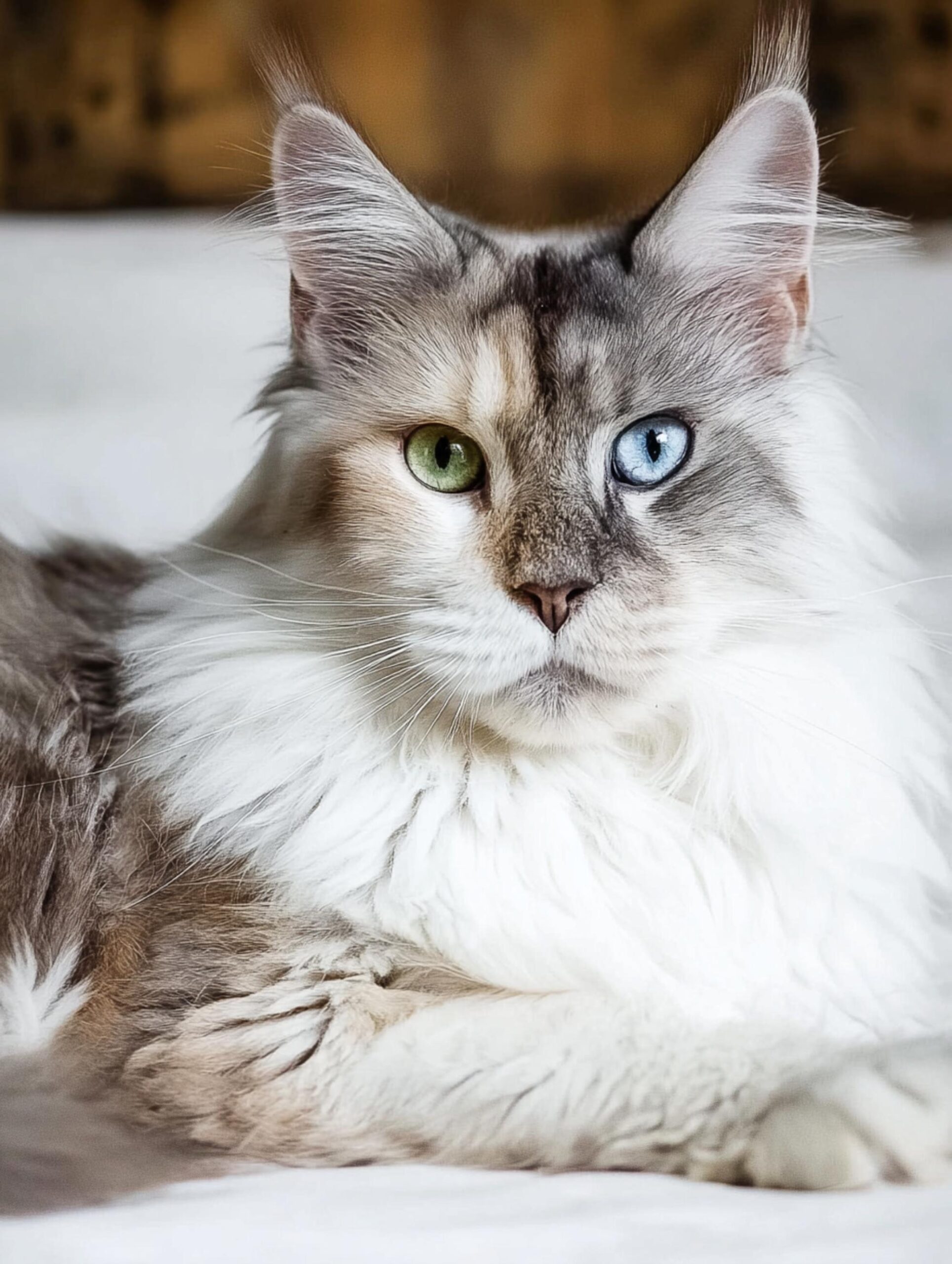
Odd-Eyed Maine Coons
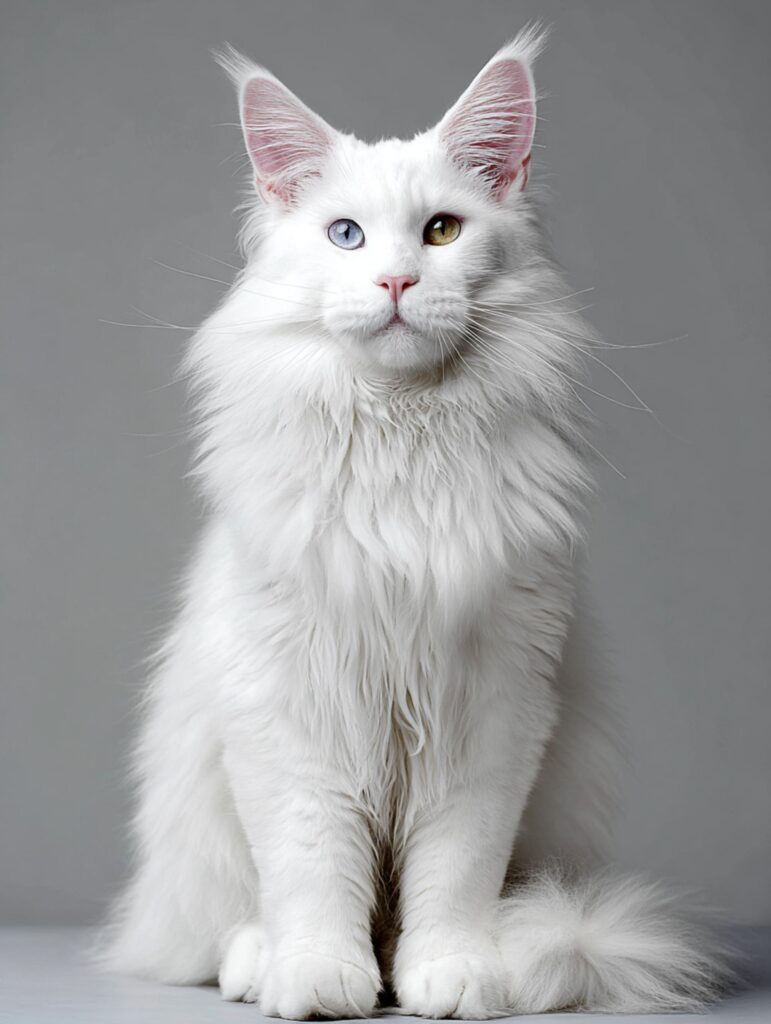
Odd-eyed Maine Coons draw attention because their eyes differ in color, but the genetics behind this trait are often misunderstood. In Maine Coons, odd eyes usually result from uneven pigment development between the two eyes, most commonly linked to white spotting genetics rather than a separate eye-color gene.
This post explains how odd eyes form, what they do and do not mean for health, how registries and breeders view them, and what buyers should understand before choosing an odd-eyed Maine Coon.
Odd-Eyed Maine Coons — At-a-Glance Summary
| Topic | Key Takeaway |
|---|---|
| What “Odd-Eyed” Means | A difference in eye color between the two eyes or within one eye, known as heterochromia. |
| Primary Genetic Cause | Uneven pigment migration, most commonly linked to white spotting genetics. |
| Separate Eye-Color Gene | No. Odd eyes do not result from a standalone eye-color gene. |
| Relationship to White | Often associated with some degree of white, even when subtle. |
| When Odd Eyes Develop | Eye color settles after kittenhood once pigment stabilizes in the iris. |
| Permanence | Odd eyes are permanent once pigment development completes. |
| Hearing Considerations | Risk depends on genetic pathway and white coverage, not eye color alone. |
| Vision Impact | Odd eyes do not impair vision. |
| Registry Recognition | Generally not emphasized in breed standards; may affect show eligibility. |
| Market Demand | Uncommon and visually distinctive, sometimes priced higher due to novelty. |
| Quality Indicator | Eye color does not indicate superior health, structure, or temperament. |
| Buyer Guidance | Choose breeders who explain genetics clearly and share adult outcomes. |
Snippet target:
Odd eyes in Maine Coons occur when pigment develops differently in each eye and are most commonly linked to white spotting genetics rather than a separate eye-color gene.
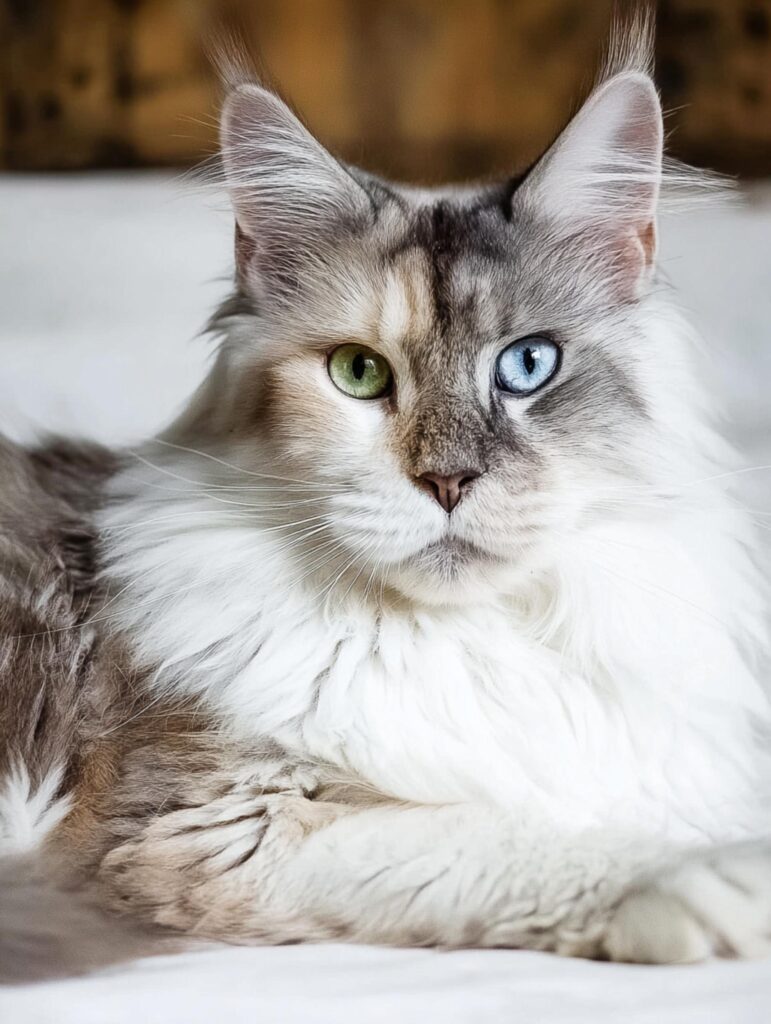
Quick Answer — What Causes Odd Eyes in Maine Coons?
Odd eyes in Maine Coons occur when pigment cells develop unevenly between the two eyes during early growth. Genetically, “odd-eyed” describes a difference in iris pigmentation, not a disease or defect. In Maine Coons, the most common cause is white spotting genetics, which can interrupt pigment migration to one eye but not the other. This outcome is uncommon because it requires a specific developmental pattern, but it is not mysterious or rare in cats overall. It reflects how pigment distributes during formation, not a separate eye-color gene acting on its own.
What “Odd-Eyed” Means in Cats
Definition of Heterochromia
“Odd-eyed” is the common term for heterochromia, a condition in which the two eyes differ in color. In cats, this difference results from variations in how much pigment reaches each iris during development.
Complete Heterochromia vs Sectoral Heterochromia
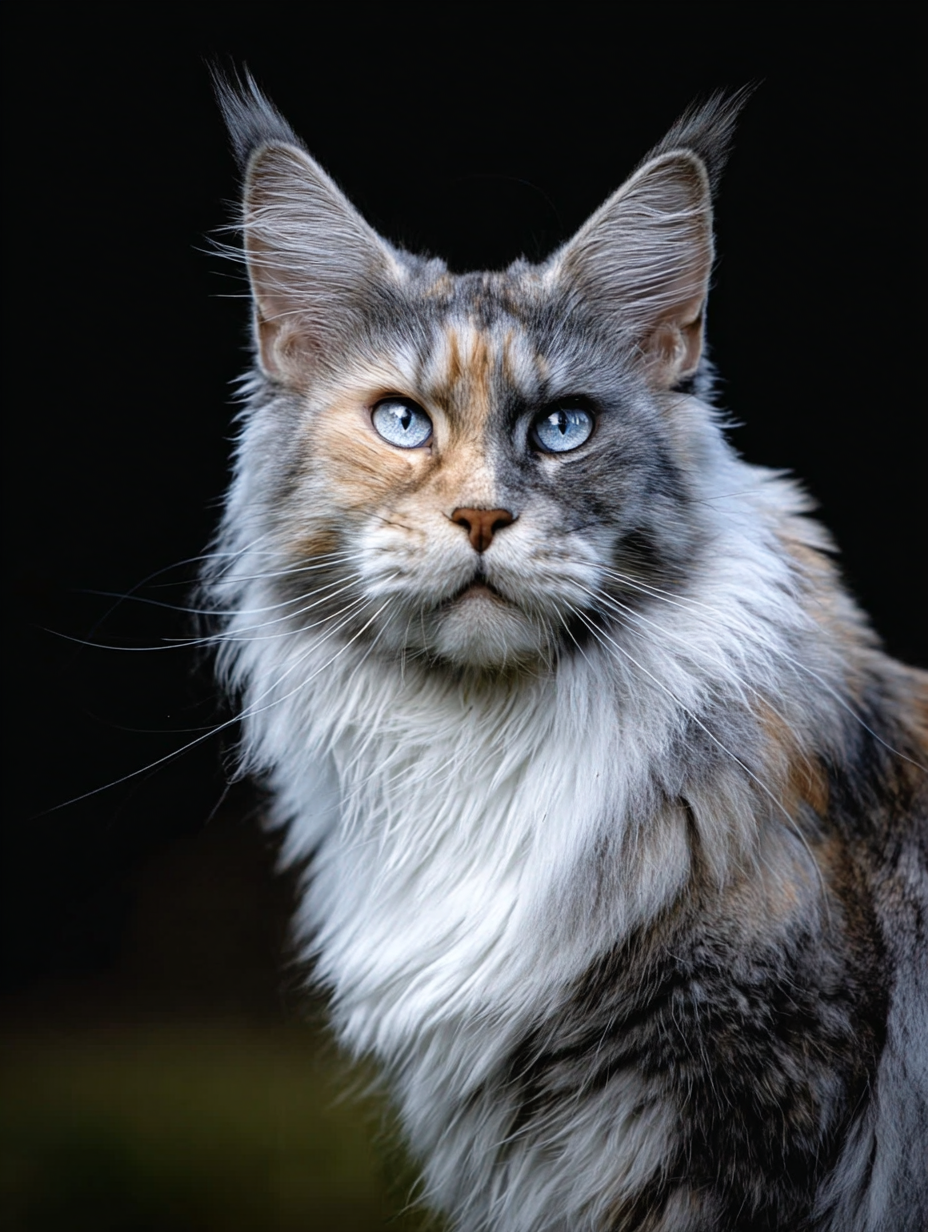
- Complete heterochromia means one eye appears fully blue while the other appears green, gold, or copper.
- Sectoral heterochromia means one eye contains two colors, often with a blue section alongside a pigmented section.
Both forms occur naturally and reflect pigment distribution rather than instability or illness.
Pigment Distribution vs Eye Damage
Odd eyes do not indicate eye damage, blindness, or injury. The eyes function normally. The difference lies only in melanin presence, not in eye structure or vision. Understanding this distinction helps separate normal genetic variation from unfounded health concerns.
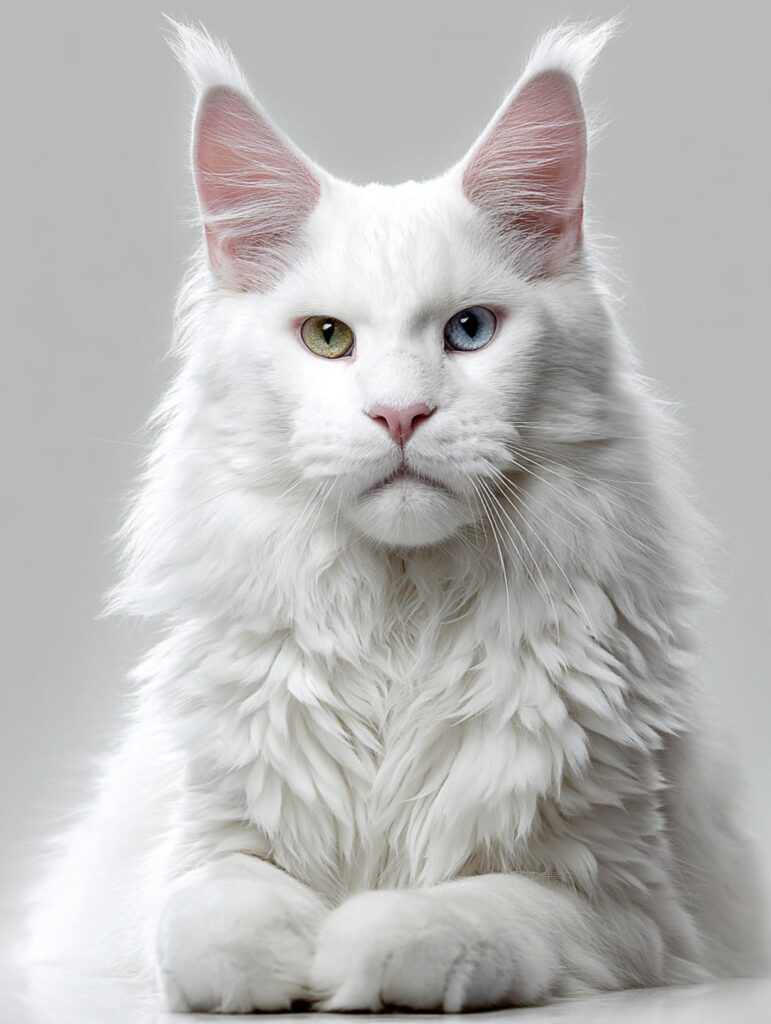
The Main Genetic Causes of Odd Eyes in Maine Coons
Odd eyes in Maine Coons arise from how pigment cells move and settle during early development. The outcome depends on where pigment cells reach the iris and where they do not, not on damage or later change.
White Spotting and Pigment Migration (Primary Cause)
White spotting genetics influence how pigment cells migrate from the neural crest to the skin, hair, and eyes while the kitten develops.
- How white spotting affects pigment cell migration
White spotting can interrupt or redirect pigment cell movement. When pigment cells fail to reach certain areas, those areas remain unpigmented. - Why one eye may develop pigment while the other does not
Pigment migration does not always occur symmetrically. One eye may receive normal pigment deposition, while the other receives little or none. This uneven distribution produces one blue eye and one pigmented eye. - Relationship between white coverage and eye color outcome
Higher white coverage increases the likelihood of blue or odd eyes, but it does not guarantee them. Some cats with minimal white still develop odd eyes, while others with extensive white develop fully pigmented eyes. The outcome depends on how pigment cells migrate during a narrow developmental window.
This mechanism explains why odd eyes appear most often in cats with some degree of white spotting, even when the white is subtle.
Sectoral Pigment Expression
Sectoral eye color occurs when pigment interruption affects only part of the iris, rather than the entire eye.
- How partial pigment interruption creates split or marbled eyes
When pigment cells reach some areas of the iris but not others, the eye develops two colors. This produces a marbled or pie-shaped appearance within a single eye. - Why sectoral blue eyes occur more often than full odd eyes
Partial interruption requires less disruption than complete absence of pigment in one eye. For that reason, sectoral blue eyes appear more frequently than full heterochromia. - Why this does not indicate instability or disease
Sectoral eyes reflect normal developmental variation. Once pigment settles, the eye color remains stable. The eye functions normally, and the condition does not progress or worsen over time.
Are Odd Eyes the Same as Dominant Blue Eyes?
Odd eyes and dominant blue eyes involve different genetic mechanisms and should not be grouped together.
- Clear genetic distinction between odd eyes and dominant blue eyes
Odd eyes result from uneven pigment migration, usually linked to white spotting. Dominant blue eyes result from a separate genetic mechanism that directly affects eye pigmentation. - Why dominant blue eyes do not require white
Cats with dominant blue eyes can have fully pigmented coats with no white at all. The gene acts on eye color independently of coat pattern. - Why odd eyes almost always involve pigment migration pathways
Odd eyes reflect where pigment cells do or do not arrive during development. This process connects directly to white spotting genetics rather than to a standalone eye-color gene.
Understanding this distinction prevents confusion and helps buyers evaluate eye color accurately without assuming shared risks or inheritance patterns.
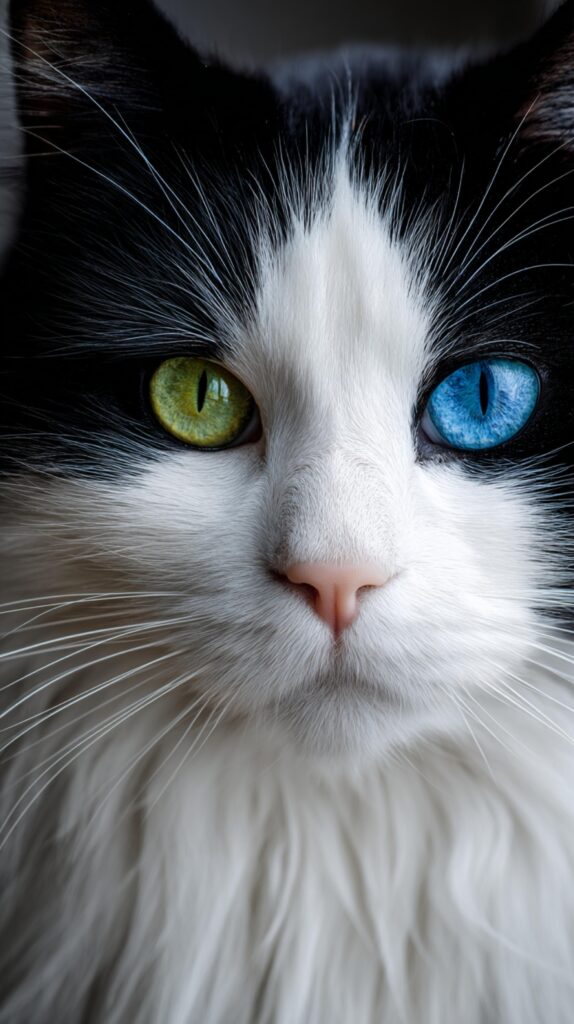
How Odd Eyes Develop From Kittenhood to Adulthood
Odd eyes in Maine Coons become clear only after normal eye development runs its course. Early eye color often creates confusion because all kittens follow the same starting pattern.
Why all kittens start with blue eyes
Newborn kittens lack active pigment production in the iris. This temporary blue appearance occurs in all kittens, regardless of their adult eye color, and does not indicate future eye outcomes.
When pigment settles into the iris
Between several weeks and a few months of age, pigment cells begin producing melanin in the iris. Eye color gradually shifts from blue to green, gold, copper, or remains blue depending on how much pigment reaches each eye.
When odd eyes become permanent
Odd eyes become permanent once pigment production stabilizes. If one eye receives pigment while the other does not, the contrast remains into adulthood. After this stage, eye color does not change further under normal circumstances.
Why early eye color can mislead buyers
Photos taken during early development capture transitional stages, not final outcomes. A kitten may appear to have two blue eyes initially and later develop odd eyes, or appear uneven temporarily before settling. Reliable identification requires patience and time.
Health Considerations for Odd-Eyed Maine Coons
Odd eyes themselves do not create health problems. Health considerations depend on the genetic pathway involved, not on eye color alone.
Hearing Considerations
White spotting genetics can affect pigment development in both the eyes and the inner ear.
- Relationship between white spotting, blue eyes, and deafness
Cats with extensive white spotting and blue eyes carry a higher documented risk of congenital deafness. This association stems from pigment migration issues during development. - Why risk depends on genetic pathway, not eye color alone
Odd eyes caused by white spotting may carry some risk, while odd eyes caused by partial pigment interruption without extensive white may not. Eye color alone does not determine hearing ability.
Many odd-eyed Maine Coons hear normally, particularly when white coverage is minimal.
Vision Considerations
Odd-eyed Maine Coons do not experience vision problems because of eye color differences.
- Why odd eyes do not impair vision
Eye color reflects pigment levels in the iris, not eye structure or function. Both eyes develop normally and process visual information correctly. - Common myths about blindness
Myths often link blue or odd eyes to blindness. These claims lack evidence. Odd-eyed cats see normally unless an unrelated eye condition exists.
What Is Known vs What Is Assumed
Clear distinction between evidence and assumption protects both buyers and the breed.
- Separating documented associations from fear-based claims
Documented links exist between extensive white spotting and deafness. No evidence links odd eyes themselves to vision loss or neurological disease. - Why ethical breeders monitor rather than speculate
Responsible breeders track hearing, eye health, and adult outcomes instead of making absolute claims. Monitoring allows informed decisions without exaggeration or fear.
Understanding these distinctions helps buyers evaluate odd-eyed Maine Coons with clarity rather than assumption.
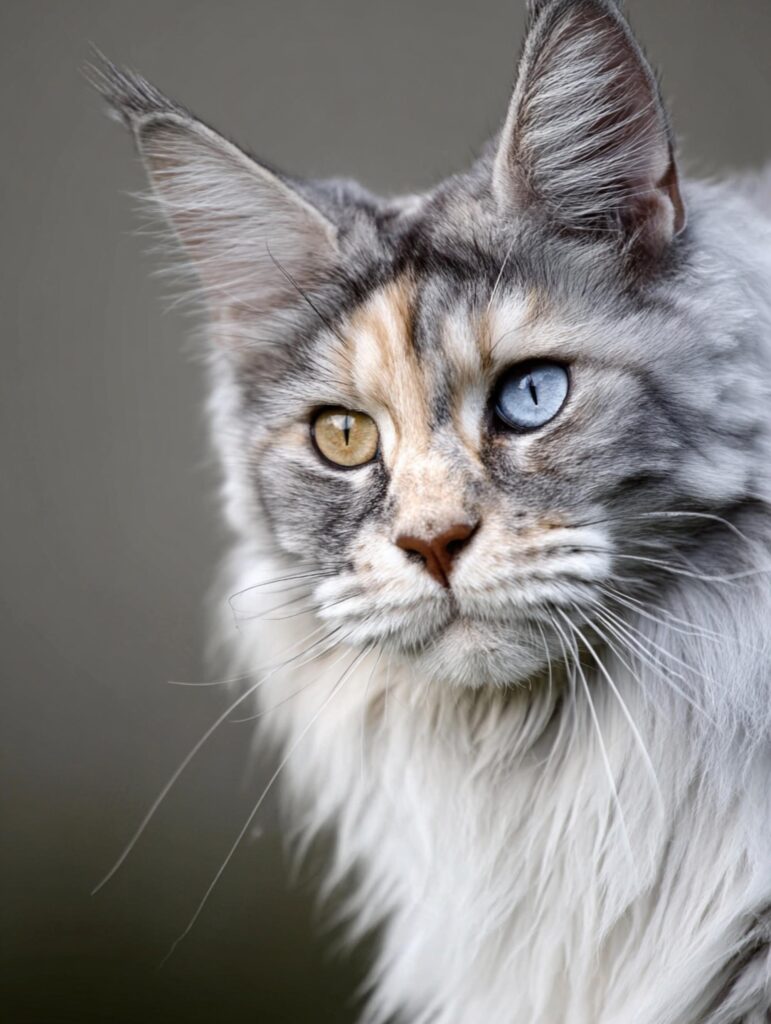
Are Odd-Eyed Maine Coons Recognized by Registries?
Registries evaluate eye color through the lens of breed standards, not market trends. Understanding this distinction helps buyers align expectations.
How breed standards address eye color
Most registries prioritize eye color uniformity and clarity within the Maine Coon standard. While standards allow a range of eye colors, they typically do not promote odd eyes as a desired or defining feature of the breed.
Show eligibility considerations
Odd-eyed Maine Coons may face limitations or penalties in the show ring depending on the registry and the context of the standard being applied. Judges assess conformity to the standard first, and eye color variation can affect placement even when the cat excels in structure and condition.
Difference between pet placement and show context
Registry standards govern show competition, not companionship. An odd-eyed Maine Coon can make an exceptional pet regardless of show eligibility. Buyers should separate show goals from pet placement and decide which matters to them before selecting a kitten.
Pricing and Market Demand for Odd-Eyed Maine Coons
Odd-eyed Maine Coons attract attention, and that attention influences pricing. Market dynamics, not genetics alone, drive these differences.
Why odd-eyed cats may command higher prices
Some buyers actively seek visual uniqueness. Limited availability combined with novelty can raise prices, especially in programs that place kittens selectively and produce small numbers.
Novelty vs genetic rarity
Odd eyes are uncommon, but they are not genetically rare in cats overall. In Maine Coons, controlled breeding choices limit how often odd eyes appear. That restraint creates scarcity, which buyers sometimes mistake for rarity.
Why eye color does not equal higher quality
Eye color does not improve health, structure, or temperament. Ethical breeders evaluate kittens on the same standards regardless of eye color. Higher prices reflect demand and availability, not superiority.
How Ethical Breeders Talk About Odd Eyes
Responsible breeders use clear, measured language and avoid overstating outcomes. Their communication reveals experience and intent.
Language used by transparent programs
Ethical breeders describe odd eyes factually and without hype. They explain what the eye color indicates genetically and what it does not.
How breeders explain genetic cause
Experienced programs connect odd eyes to pigment migration and white spotting pathways. They explain development clearly and place eye color in context rather than presenting it as a selling point.
Why guarantees and exaggeration are avoided
Breeders cannot guarantee visual traits that depend on developmental processes. Ethical programs avoid absolute claims, focus on education, and prioritize health, structure, and temperament over appearance alone.
These communication patterns help buyers identify programs grounded in responsibility rather than marketing.
Red Flags in Odd-Eyed Marketing
Odd eyes attract attention, which makes them easy to misuse in marketing. Certain claims and presentation styles signal exaggeration rather than education.
Claims of “ultra rare mutation”
Odd eyes do not result from a mysterious or newly discovered mutation. When sellers frame them this way, they inflate novelty to justify price or urgency. Ethical breeders describe odd eyes as an uncommon outcome of known genetic processes, not as a breakthrough trait.
No explanation of white spotting genetics
Odd eyes in Maine Coons almost always connect to pigment migration and white spotting pathways. Marketing that avoids this explanation or refuses to discuss genetics often relies on appearance alone and leaves buyers without essential context.
Focus on appearance without health context
When listings emphasize eye color but omit health testing, hearing considerations, or overall structure, priorities are misaligned. Eye color should never overshadow health, temperament, and longevity in a well-run program.
Fear-based or hype-driven messaging
Some marketing exaggerates risk to create drama, while other messaging dismisses all questions as irrelevant. Both extremes mislead buyers. Ethical communication stays factual, balanced, and calm.
How to Evaluate an Odd-Eyed Maine Coon as a Buyer
Buyers can make confident decisions by focusing on genetics, outcomes, and transparency rather than novelty.
Questions buyers should ask
Ask breeders to explain:
- What genetic pathway produced the odd eyes
- How often odd eyes appear in their program
- What adult cats from these lines look and function like
Clear, consistent answers matter more than polished listings.
Genetic context that should be disclosed
Responsible breeders explain the role of white spotting and pigment migration. They disclose relevant genetic testing and place odd eyes within the broader genetic profile of the cat, not as an isolated feature.
Why adult outcomes matter
Adult cats reveal stability in eye color, hearing, health, and temperament. Breeders who share adult photos, long-term observations, and honest evaluations reduce uncertainty and demonstrate experience.
How to assess health responsibly
Evaluate the same factors you would for any Maine Coon:
- Cardiac and orthopedic health screening
- Hearing awareness where applicable
- General vitality and temperament
Eye color alone does not define health. Responsible evaluation looks at the whole cat, not a single visual trait.
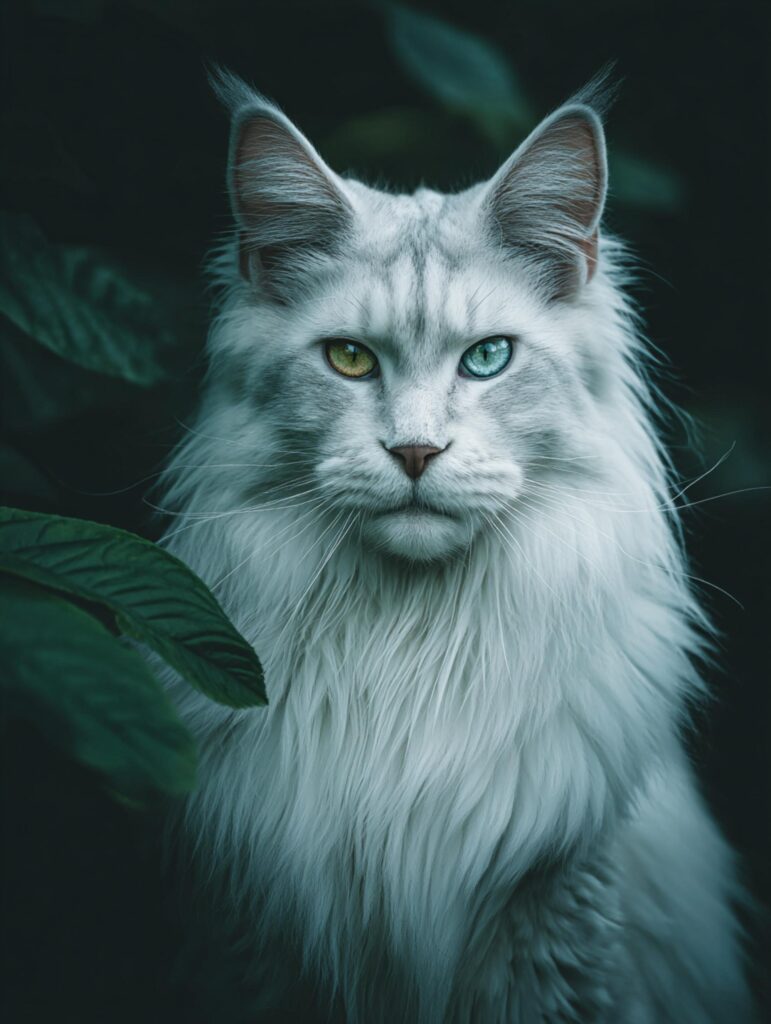
Odd-Eyed Maine Coon FAQ
What does “odd-eyed” mean in Maine Coons?
Odd-eyed refers to heterochromia, a condition where each eye has a different color or where one eye contains multiple colors. In Maine Coons, this usually means one blue eye and one green, gold, or copper eye, or a single eye with both blue and pigmented sections.
Are odd-eyed Maine Coons rare?
Odd-eyed Maine Coons are uncommon but not genetically rare. They appear infrequently because they depend on specific pigment migration patterns, often linked to white spotting genetics. Breeding choices, not genetic impossibility, limit how often they appear.
What causes odd eyes in Maine Coons?
Odd eyes occur when pigment cells develop unevenly between the two eyes during early development. In Maine Coons, this outcome most often connects to white spotting genetics, which can interrupt pigment migration to one eye but not the other.
Are odd eyes caused by a separate eye-color gene?
No. Odd eyes do not come from a standalone eye-color gene. They result from how pigment cells migrate and settle during development, usually influenced by white spotting pathways rather than a dedicated eye-color mutation.
Are odd eyes the same as dominant blue eyes?
No. These are genetically different phenomena.
- Odd eyes usually involve pigment migration linked to white spotting.
- Dominant blue eyes result from a separate genetic mechanism that directly affects eye pigmentation and does not require white.
Confusing the two leads to incorrect assumptions about inheritance and health. See more about Dominant Blue Eyed Maine Coons here.
Can an odd-eyed Maine Coon have no white at all?
Most odd-eyed Maine Coons have some degree of white, even if it is minimal or not immediately obvious. Completely non-white odd-eyed cats are extremely uncommon and should prompt careful genetic explanation from the breeder.
Do odd-eyed Maine Coons hear normally?
Many odd-eyed Maine Coons hear normally. Hearing risk depends on the genetic pathway, not on eye color alone.
Cats with extensive white spotting and blue eyes carry a higher documented risk of congenital deafness. Cats with minimal white or sectoral eye color often hear normally.
What percentage of odd-eyed Maine Coons are deaf?
There is no reliable breed-specific percentage for odd-eyed Maine Coons. Deafness rates often cited online come from studies of fully white, blue-eyed cats across breeds, not from odd-eyed Maine Coons specifically.
Any breeder claiming a precise percentage for odd-eyed Maine Coons is overstating available data.
Do odd eyes affect vision?
No. Odd eyes do not impair vision. Eye color reflects pigment in the iris, not eye structure or visual function. Odd-eyed Maine Coons see normally unless an unrelated eye condition exists.
Can an odd-eyed kitten lose the odd eye as it grows?
No. Once pigment settles and eye color stabilizes, odd eyes remain permanent. Early kitten photos may mislead buyers because all kittens start with blue eyes and pigment develops later.
When can breeders reliably identify odd eyes?
Breeders can identify odd eyes reliably after pigment settles, usually several weeks to a few months into development. Early identification before pigment stabilization is not reliable.
Are odd-eyed Maine Coons accepted in cat shows?
Most registries do not promote odd eyes as a desired trait within the Maine Coon breed standard. Odd-eyed Maine Coons may face show eligibility limitations depending on registry rules and judge interpretation.
This does not affect their suitability as pets.
Are odd-eyed Maine Coons more expensive?
They can be. Some odd-eyed Maine Coons command higher prices due to novelty and buyer interest. Pricing reflects market demand, not superior health, temperament, or structure.
Does a higher price mean a better cat?
No. Eye color does not determine quality. Health testing, structure, temperament, and breeder practices matter far more than eye color.
Do ethical breeders intentionally breed for odd eyes?
Most ethical breeders do not breed specifically for odd eyes. When odd eyes appear, breeders explain the genetics honestly and place kittens responsibly rather than treating eye color as a breeding goal.
What language should buyers expect from ethical breeders?
Ethical breeders:
- Explain pigment migration and white spotting clearly
- Avoid exaggeration or guarantees
- Place eye color in context rather than as a selling point
- Discuss health and development openly
What marketing claims should buyers avoid?
Buyers should be cautious of:
- Claims of “ultra rare mutation”
- Listings that avoid genetic explanation
- Messaging that focuses only on appearance
- Fear-based claims about blindness or guaranteed deafness
These patterns signal hype, not education.
What questions should buyers ask breeders?
Buyers should ask:
- What genetic pathway caused the odd eyes?
- How much white is present in the line?
- What adult outcomes have you observed?
- What health testing and monitoring do you perform?
Clear answers matter more than confident marketing.
Should buyers avoid odd-eyed Maine Coons?
No. Buyers should not avoid odd-eyed Maine Coons by default. They should approach them with the same thoughtful evaluation used for any Maine Coon, focusing on health, transparency, and breeder ethics.
What is the most responsible way to choose an odd-eyed Maine Coon?
The most responsible approach includes:
- Understanding the genetic cause
- Reviewing adult outcomes
- Evaluating health and temperament first
- Choosing breeders who educate rather than hype
Eye color should remain a visual detail, not the deciding factor.
Odd Eye Maine Coon Summary
Odd-eyed Maine Coons develop when pigment settles differently in each eye during early development, most commonly due to white spotting genetics that affect pigment migration. This difference in eye color, known as heterochromia, is a natural variation and does not represent a separate eye-color gene, a defect, or an indicator of poor health on its own. Odd eyes are uncommon in Maine Coons because they require a specific developmental outcome, but they are well understood within feline genetics.
Health considerations depend on the underlying genetic pathway rather than eye color alone. Many odd-eyed Maine Coons hear and see normally, particularly when white coverage is limited. Ethical breeders focus on transparency, explain the genetic cause clearly, avoid exaggerated claims, and prioritize health, structure, and temperament over appearance. For buyers, the most reliable approach is to evaluate genetics, adult outcomes, and breeder practices rather than novelty or marketing language.
Related Maine Coon Posts
If you’re continuing your research, these guides expand on key topics mentioned above:
- Dominant Blue Eyed Maine Coon Dominant blue eyes in Maine Coons are caused by a separate genetic mechanism from colorpoint
- Maine Coon Kitten Colors Explained
Learn how Maine Coon coat colors appear in kittens, why early color can be misleading, and how to set realistic expectations as coats mature. - Maine Coon Colors: Complete Genetics, Identification, and More
A detailed breakdown of Maine Coons Colors. - Maine Coon Pricing Explained: What Goes Into the Cost of a Well-Bred Kitten
Understand how breeding practices, health testing, and care standards influence pricing—separate from color myths. - The Lifetime Cost of Owning a Maine Coon
A realistic look at long-term expenses, veterinary care, and planning for a 12–15+ year commitment. - Is a Maine Coon A Good First Time Cat
A practical guide to lifestyle fit, grooming needs, and what daily life with a Maine Coon actually looks like. - Black Smoke Maine Coon Coats: Genetics, Identification, and Cost
A detailed breakdown of black smoke Maine Coons, explaining how smoke coats differ from silver tabby and shaded patterns, and why black smoke is so often misidentified. - Shaded vs Smoke Maine Coon Colors What’s the difference.
Sources & References
- Lyons, L. A. (2015). Feline Genetics and Genomics.
University of Missouri College of Veterinary Medicine.
https://felinegenetics.missouri.edu - Robinson, R. (1991). Genetics for Cat Breeders. Butterworth-Heinemann.
(Foundational reference on pigment migration, eye color variation, and heterochromia.) - Vella, C. M., Shelton, L. M., McGonagle, J. J., & Stanglein, T. W. (1999). Robinson’s Genetics for Cat Breeders and Veterinarians. Elsevier.
(Detailed explanation of white spotting genetics, eye color outcomes, and developmental pigment pathways.) - Strain, G. M. (2011). Congenital Deafness in Domestic Animals.
The Veterinary Journal.
(Primary reference on associations between white spotting, blue eyes, and deafness.) - The International Cat Association (TICA). Maine Coon Breed Standard and Eye Color Guidelines.
https://tica.org - Cat Fanciers’ Association (CFA). Maine Coon Breed Profile and Standards.
https://cfa.org - The Governing Council of the Cat Fancy (GCCF). Colour and Eye Colour Definitions.
https://www.gccfcats.org









Read the Comments +