
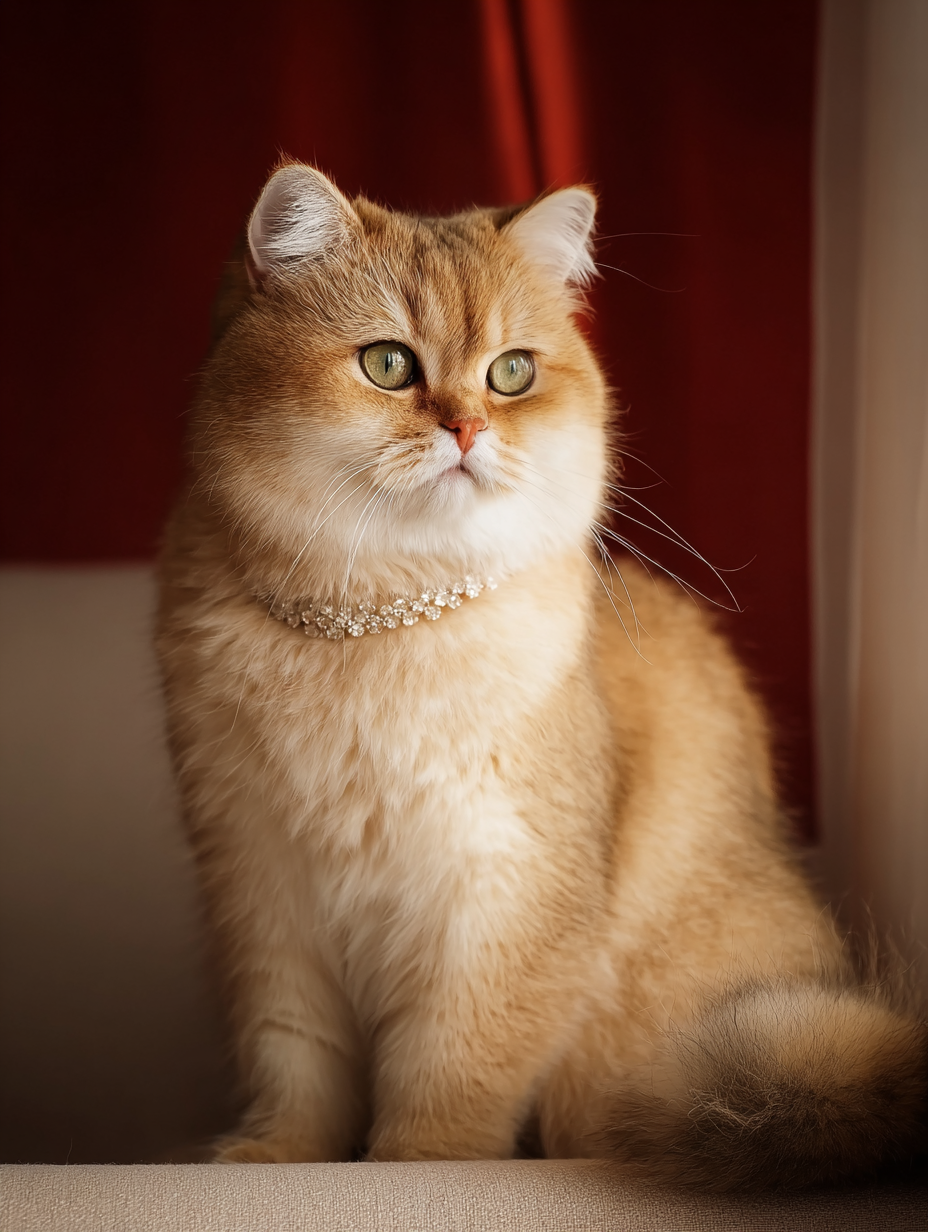
What Is a Golden British Shorthair?
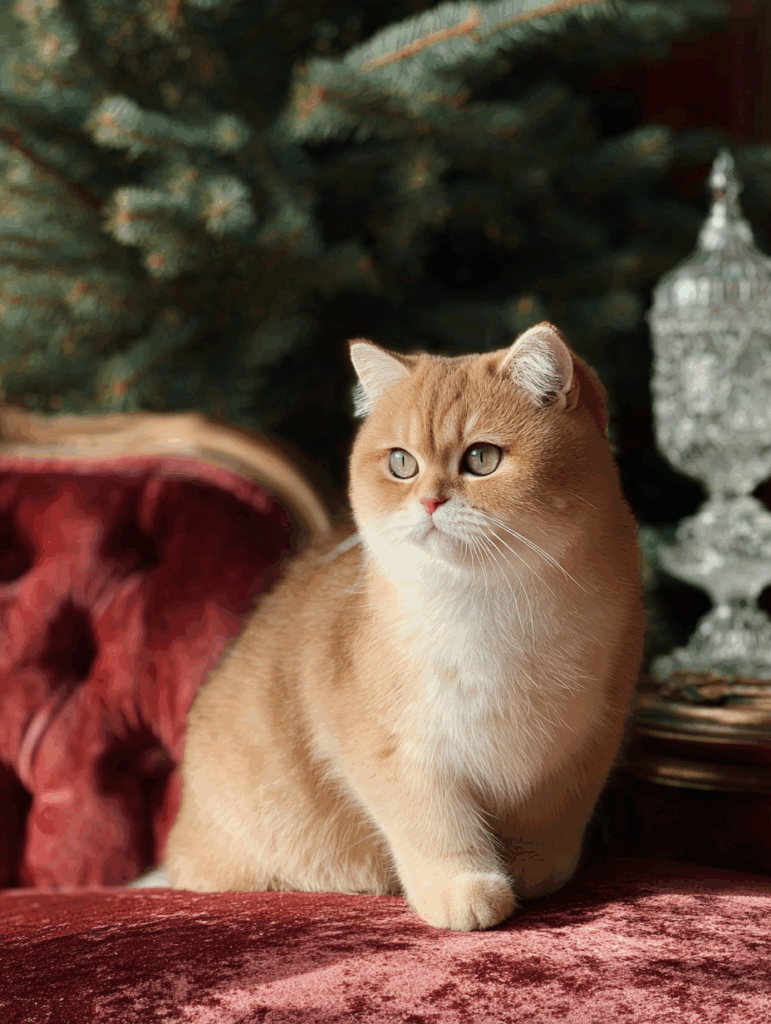
A Golden British Shorthair is a British Shorthair with a warm apricot or golden undercoat and dark tipping or shading on the outer part of the fur. The golden appearance comes from a combination of Agouti-based pattern genes and widebanding genes that lighten the lower portion of each hair. This produces the signature warm tone seen in golden shell, golden shaded, and golden ticked cats.
Buyers often see letter–number codes (ny, ay, by + 11, 12, 25).
These codes describe:
• the base color (black, blue, chocolate, lilac, cinnamon, fawn)
• the pattern type (tipped, shaded, ticked)
• the intensity of the golden undercoat
- A golden chinchilla (ny12) has very light tipping and a bright golden base.
- A golden shaded (ny11) has more visible shading along the back and sides.
- A golden ticked (ny25) shows even ticking instead of stripes.
Golden British Shorthairs are considered rare because the widebanding genes, inhibitor variants, and rufous modifiers required to express the color consistently are not common in the breed. Producing stable golden tone across the undercoat requires specific pairings and selective breeding.
What Does a Golden British Shorthair Look Like?
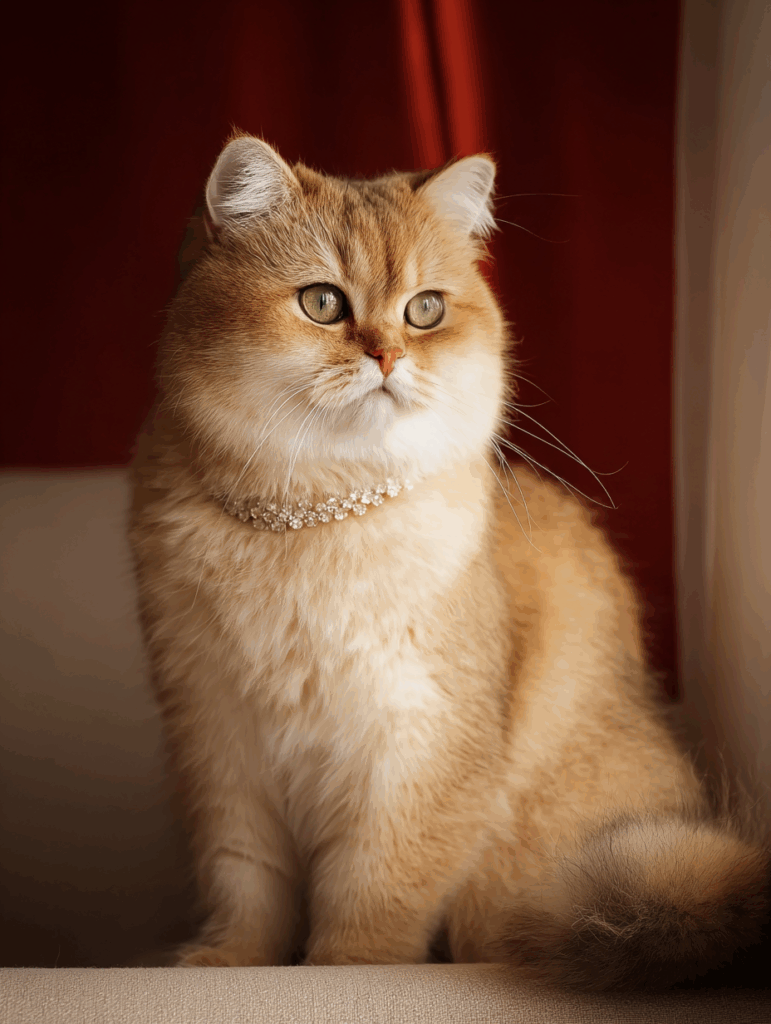
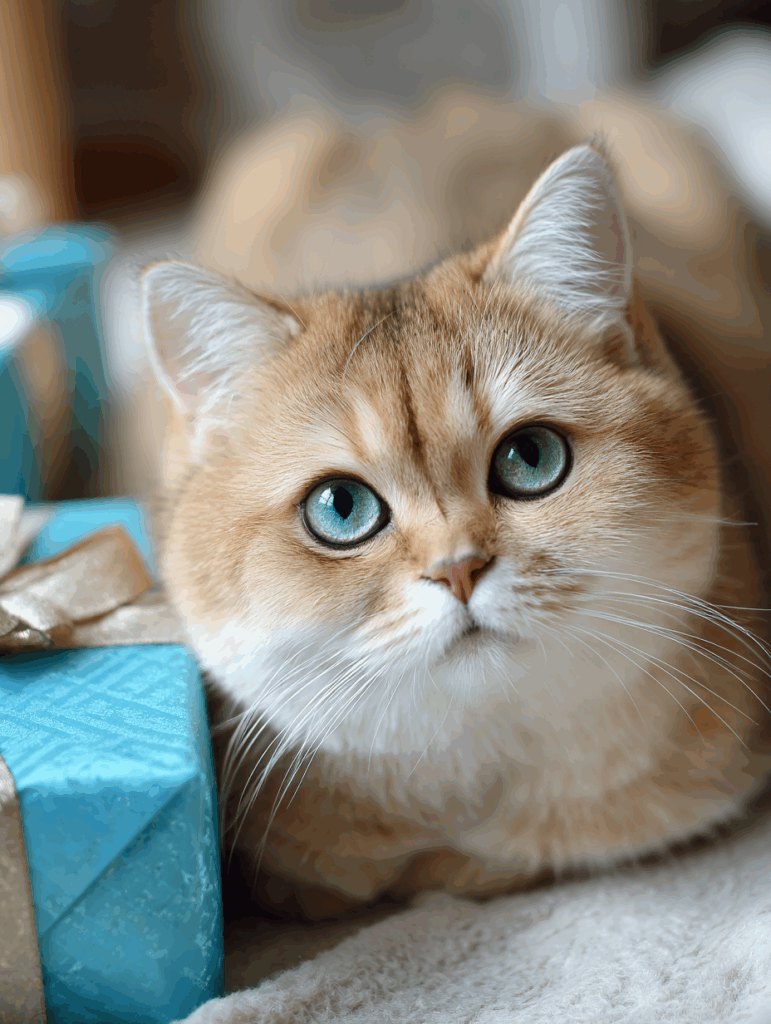
A Golden British Shorthair has a warm, glowing coat that blends a light apricot undercoat with darker tipping along the back, sides, and tail. The result is a soft, sunlit appearance that stands out from every other British Shorthair color. The golden tone is not a single shade — it is a combination of undercoat warmth, pigment distribution, and tipping depth that creates a distinctive “radiant” look.
Most golden British Shorthairs share several defining traits:
Warm Apricot or Honey Undercoat
The base of the coat is always a warm tone — usually apricot, honey, soft peach, or light gold.
This warm foundation is what separates goldens from silver or cream cats. Even in kittens, the undercoat carries a subtle golden hue that deepens and becomes more even as they mature.
Dark Tipping Along the Back and Body
Each hair has a light-colored base with a darker pigment at the top.
Depending on type:
- Golden Shell (12): Very light undercoat with only the top 1/8 of the hair tipped
- Golden Shaded (11): Warm undercoat with 1/3 of the hair tipped
- Golden Ticked (25): Even ticking across the entire coat with no stripes
- Golden Tabby (22/23/24): Undercoat is golden, pattern appears in darker pigment
The balance between warm undercoat and dark tipping creates the “golden glow.”
Rounded British Shorthair Head and Expression
Golden British Shorthairs still follow classic British structure:
- full, round cheeks
- large, open eyes
- thick, sturdy body
- dense, plush coat
The golden color enhances these features by adding brightness around the muzzle and eyes.
Black Lining Around Nose, Eyes, and Lips
Most goldens show:
- black eyeliner
- black lip outline
- a brick or rose-toned nose leather
These details are part of the agouti-based golden color and give the face a striking, expressive look.
Green Eyes in Adults (Most Common)
Many golden British Shorthairs develop:
- green
- blue-green
- hazel-green
Eye color matures slowly. Kittens often start with blue or muddy transitional tones before reaching their final vivid shade.
Thick Plush Coat With Soft Texture
The coat is dense and plush, with a luxurious hand-feel.
Golden shading tends to enhance coat depth and makes the texture appear even fuller.
Longhair variants have a flowing, soft coat with warm shading through the breeches, ruff, and tail plume.
Kittens vs. Adults
Kittens are often:
- lighter
- less defined
- more “peachy” than golden
As they mature, the warm undercoat strengthens, and tipping becomes more controlled, revealing the true adult shade.
Overall Impression
A Golden British Shorthair looks like a classic British teddy bear with a warm, glowing coat that catches light beautifully. Whether shell, shaded, or ticked, the golden color creates a soft radiance that sets this variety apart from all other British Shorthair patterns.
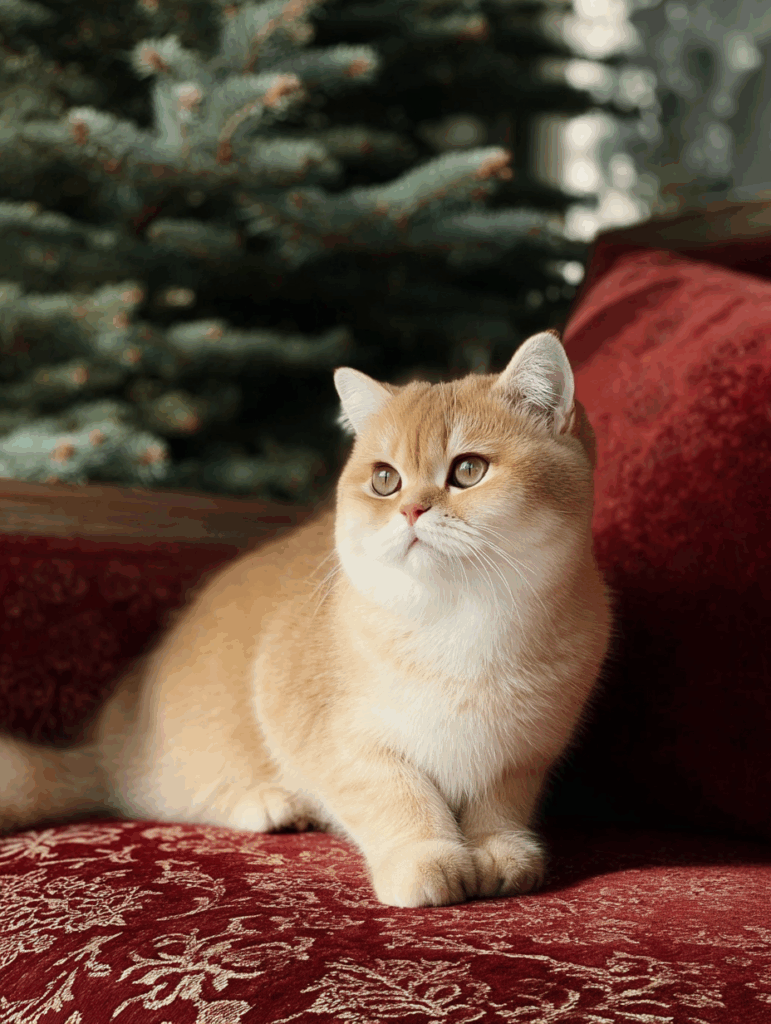
Are Golden British Shorthairs Rare?
Golden British Shorthairs are considered one of the rarer color classes in the breed. Their scarcity is not due to low demand, but because the genetics behind the golden coat require several specific gene combinations to line up correctly. Only a small number of breeders worldwide work consistently with these lines, which keeps the color less common than blue, lilac, or silver.
Why Golden British Shorthairs Are Less Common
Several factors contribute to the rarity:
1. Multiple genes are required to produce the golden tone.
The wideband system (Wb), agouti (A), and inhibitor/silvering complexes (Sv/Bl/I) must interact in a specific way for the warm golden undercoat and correct tipping to appear. Many litters carry partial expressions rather than the full, rich golden tone.
2. Not all golden kittens mature into high-quality adults.
Golden kittens may look warm or peach-toned at birth but develop too much pattern, too little warmth, or unstable tipping as they grow. This makes consistent breeding more challenging.
3. Limited global bloodlines.
Strong golden lines originate from only a few established catteries. Maintaining quality requires selective pairing and genetic diversity, which limits how many golden kittens are produced each year.
4. The color was refined more recently compared to classic British colors.
Blue and lilac have decades of widespread development. Golden colors are newer, with ongoing refinement in shell, shaded, ticked, and flaxen varieties.
Are Golden Longhair British Shorthairs Even Rarer?
Yes.
Golden longhair British Shorthairs are significantly rarer because:
- the longhair gene is recessive, so both parents must carry it
- the golden gene combinations must also align
- longhair coats reveal tipping and shading more dramatically, requiring careful selection
The combination of longhair + golden + correct wideband expression is uncommon worldwide.
Why Golden British Shorthairs Are in High Demand
Even though production numbers are low, interest in the color continues to grow because:
- the warm, glowing coat stands out from traditional British colors
- the golden shaded and golden shell varieties have a luminous, radiant appearance
- photos and videos of golden cats circulate widely on social platforms
- the color is associated with premium, well-selected lines
This demand often exceeds the number of available kittens, contributing to the perception — and reality — that golden British Shorthairs are rare.
Bottom Line
Golden British Shorthairs are rare because they require precise genetic combinations, careful selection, and strong breeding lines. Production numbers remain small, and demand continues to increase. This combination keeps the golden varieties among the most sought-after colors in the British Shorthair breed.
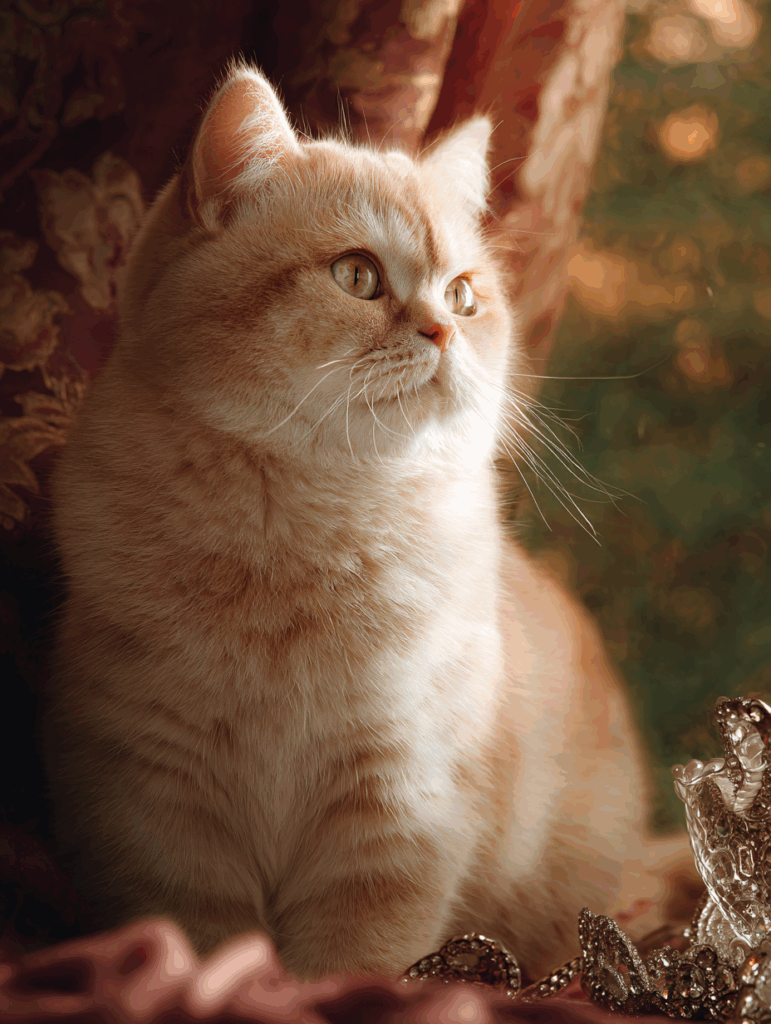
Types of Golden British Shorthairs Explained
Golden Shell (12)
• Undercoat: nearly fully golden from root to mid-shaft
• Color on hair: only the top 1/8 of each hair shows dark tipping
• Look: the lightest form of golden; coat appears bright and open
• Code examples: ny12, ay12, by12, cy12
• Genetic tendency: WbWb + svsv (strong wideband expression)
Golden Shaded (11)
• Undercoat: golden for the lower 2/3 of each hair
• Color on hair: shading covers about 1/3 of the length
• Look: warmer than shell; visible gradient across the back
• Code examples: ny11, ay11, by11
• Genetic tendency: Wbwb + svsv or WbWb with partial U expression
Golden Ticked (25)
• No stripes on the body
• Even ticked pattern with alternating light and dark bands on each hair
• Very warm golden base with minimal pattern
• Code examples: ny25, ay25, by25
• Genetic tendency: agouti + Wb influence + ticked tabby allele (Ta)
Golden Classic, Mackerel, and Spotted (22 / 23 / 24)
• Golden Classic Tabby (22): wide swirls with golden background
• Golden Mackerel Tabby (23): parallel narrow striping
• Golden Spotted Tabby (24): round spots over a warm golden base
• Code examples: ny22, ny23, ny24
• Genetic tendency: tabby alleles + weaker widebanding influence
These patterns show more contrast than shell, shaded, or ticked, and they often express “warm apricot” tones when the wideband range is moderate.
Flaxen Golden / Sunshine Golden (v-series)
• Recently recognized color line (nv, av, bv, cv, ov, pv, dv, ev)
• Characterized by strong lightening on chest, toes, muzzle
• Minimal eye-lining, reduced outlining around nose and eyes
• Coat carries low black tipping and strong red–yellow tonal influence
• Genetic cause: believed to involve additional modifiers beyond Wb, possibly variants affecting eumelanin suppression
This line is expanding rapidly in Europe and is becoming its own recognized subtype of golden.
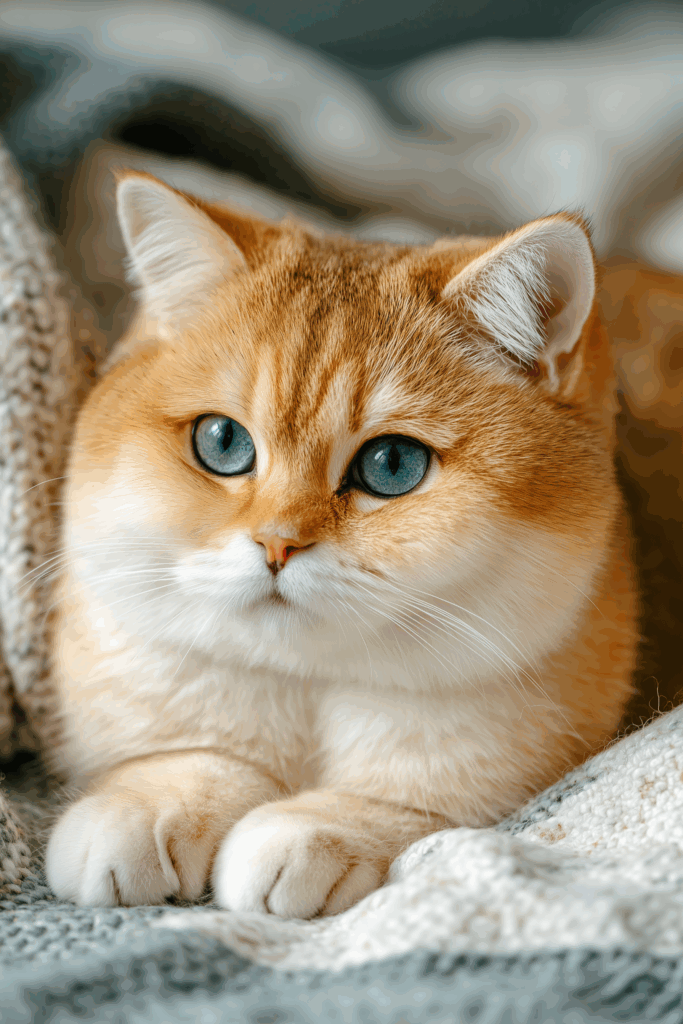
Photo-Style Examples of Golden British Shorthair Cat Colors
Golden Shell (12) — Visual Description
A cat with a nearly pale golden undercoat and extremely light dark tipping confined to the spine line, tail, and upper flanks. The face appears bright with clear contrast around the eyes, and the legs show minimal shading.
Golden Shaded (11) — Visual Description
A cat with a warm apricot undercoat and a soft gradient of darker shading across the back and sides. The belly, chest, and chin appear golden and lighter than the upper body. Eye-lining and nose contrast are clearly visible.
Golden Ticked (25) — Visual Description
Each hair shows alternating light and dark bands with no striping on the body. The coat has an even golden tone from neck to tail, with defined ticking on the shoulders and flanks. The tail shows ringed shading.
Golden Classic Tabby (22) — Visual Description
A broad swirling pattern over a golden background. The sides feature large, rounded patches of darker pigment, while the spine has two dark lines. The face has a strong tabby “M” marking.
Golden Mackerel Tabby (23) — Visual Description
Narrow vertical stripes run from the spine down the sides over a golden base. The legs show clear striping and the tail has multiple dark rings.
Golden Spotted Tabby (24) — Visual Description
Even, round spots are distributed across a rich golden background. The contrast between spots and base color is strong, with clear outlining around each spot.
Flaxen Golden — Visual Description
A warm golden tone with high lightening on the muzzle, chest, and toes. Eye-lining is minimal, giving a softer facial appearance. Tipping is reduced, and the coat appears lighter across the entire body.
Does the Golden Color Require Special Care?
Golden British Shorthairs do not require special grooming beyond standard British Shorthair care, but there are a few color-specific considerations buyers should understand.
Coat Maintenance
Golden coats contain light undercoats and dark tipping. Routine brushing removes loose undercoat and helps maintain even distribution of tipping. For longhair goldens, brushing prevents knots at the neck, chest, and breeches where the golden tone is thickest.
Tear Staining
Golden British Shorthairs have minimal tear staining risk compared to other light-coated breeds. Checking the inner corners of the eyes weekly prevents buildup and keeps the facial area evenly colored.
Color Stability and Sun Exposure
Golden coats can show mild oxidation from strong sunlight. Keeping cats indoors or limiting sun exposure preserves tipping and prevents fading on the spine line and tail.
Maintaining Tipping Quality
Tipping is the dark color at the end of the hair shaft, and maintaining its appearance depends on coat health. Balanced nutrition, omega support, and regular grooming help keep the tip intact through shedding cycles.
These care notes answer the highest-volume questions from new buyers searching for grooming expectations, shedding details, and color changes.
Basics of Golden British Shorthair Color Genetics
Golden British Shorthair and British Longhair colors look complex, but the genetics behind them follow a predictable pattern. Golden coats are created by a combination of genes that determine:
- which pigment is produced
- how much pigment is placed on each hair
- where the pigment appears (tipping vs shaded vs shell)
- whether the coat is warm golden, cool golden, or pale silver-gold
Understanding these basics helps explain why golden kittens look so different at birth and how their coats transform during the first year.
Core Golden British Shorthair Genetics Overview
| Topic | Summary | Key Terms / Keywords |
|---|---|---|
| How the Golden Color Forms | Golden coats result from interactions between agouti (A), inhibitor/silvering (Sv), wideband (Wb), and unpatterned (U) genes, which control pigment placement and tipping. | British Shorthair golden genetics, golden chinchilla genetics |
| Agouti Gene (A) | Produces banded hairs and allows pattern expression. All golden cats are Agouti. | agouti gene British Shorthair, A gene golden |
| Inhibitor / Silvering Gene (Sv / I / Bl) | Reduces pigment at the base of hairs. Needed for golden shaded and golden shell patterns. | inhibitor gene, silver gene Sv, Bl bleaching gene |
| Wideband Gene Group (Wb) | Creates broad pale areas on each hair. WbWb = shell (12), Wbwb = shaded (11), wbwb = golden tabby (22–25). | wideband gene Wb, golden shaded 11, golden tabby 22 |
| Unpatterned Gene (U) | Controls visibility of tabby pattern. UU = minimal pattern; Uu = partial; uu = clear tabby. | unpatterned gene U, pattern suppression genetics |
| Golden Color Types | Shell (12), Shaded (11), Ticked (25), Classic/Mackerel/Spotted (22–25). Defined by Wb distribution + Sv + U state. | golden shell 12, golden shaded 11, golden ticked 25 |
| Color Codes (ny, ay, by, cy, oy, py, dy, ey) | Codes depend on base pigment: black, blue, chocolate, lilac, cinnamon, fawn, red, cream. | ny black golden, ay blue golden, by chocolate golden |
| Dilution Gene (D) | Controls whether pigment appears full or diluted (blue, lilac, fawn). | D gene dilution, diluted golden British Shorthair |
Advanced British Golden Variations, Tipping & Inheritance
| Topic | Summary | Key Terms / Keywords |
|---|---|---|
| Flaxen / Sunshine Golden (v-series) | Recently approved variation with pale contrast on face and paws. Codes: nv, av, bv, cv, ov, pv, dv, ev. | flaxen golden British Shorthair, sunshine golden color |
| Difference Between Golden & Silver | Silver reduces yellow pigment; golden retains warm apricot tones through widebanding + reduced inhibitor effect. | golden vs silver British Shorthair |
| Tipping Levels Explained | Shell = 1/8 pigment; Shaded = 1/3 pigment; Tabby = full banding. | British Shorthair tipping levels, chinchilla vs shaded |
| Eye Color & Pigment Reduction | Reduced eumelanin increases green eye expression, common in golden lines. | green eyes golden British Shorthair |
| Why Golden Shades Vary | Variation comes from the intensity of Wb, Sv expression, pattern suppression, and base-color genes. | golden color variations, golden shade genetics |
| Common Golden Genotypes | Shell: svsv, UU, WbWb. Shaded: svsv, UU, Wbwb. Ticked: svsv, uu, wbwb. | golden genotype chart, British Shorthair color genetics |
| Buyer Summary | Golden British Shorthairs show warm apricot undercoats, dark tipping, stable shading, and green or hazel eyes depending on genetics. | golden British Shorthair kittens, golden chinchilla kitten |
The Two Pigments Behind Every Golden Cat
Even though we see hundreds of cat colors, all feline colors come from just two pigments:
- Black eumelanin
- Red/yellow pheomelanin
Every golden British Shorthair is built from these same pigments. Golden is not a separate pigment — it is the reduction and modification of black pigment at the base of each hair, allowing the warm yellow pigment to show through.
There are also diluted forms of black pigment (like chocolate and cinnamon), which explain why goldens can appear:
- warm golden
- soft sandy-golden
- cool blue-golden
- rich honey-golden
Even though there are many shades, they all stem from how much black pigment remains on the hair tip.
How Pigment Reaches the Coat
Early in fetal development, the body creates pigment cells that migrate to the skin and into each forming hair follicle. Two steps determine whether the cat will have color:
1. Will pigment reach the hair at all?
This is controlled by the White gene (W/w):
- w/w (recessive) → pigment cells migrate normally → the cat has color
- W/ (dominant)** → pigment cells fail to migrate → the cat is white
Golden kittens, of course, carry w/w, meaning pigment is placed correctly.
2. How the pigment is produced
The C locus controls how much pigment the coat can make:
- C (full color) = the cat can express normal color
- cs/cs (colorpoint) = pigment activates only in cooler areas, leading to golden point patterns
Golden colorpoint British Shorthairs exist and are coded similarly to Siamese, just paired with golden/shaded modifications.
The B Locus: Black, Chocolate, Cinnamon
The B gene determines the type of black pigment:
- B (black)
- b (chocolate)
- bl (cinnamon)
This explains variations such as:
- black golden shaded
- chocolate golden shaded
- cinnamon golden shaded
- blue golden shaded (diluted black)
- lilac golden shaded (diluted chocolate)
Different base colors create different golden warmth and depth.
The Dilution Gene (D/d): Why Some Goldens Look Soft Blue-Gold
Dilution does not change the golden pattern — it only softens pigment density.
- D (dense pigment) → normal black-based golden
- d/d (diluted pigment) → blue golden, lilac golden, or fawn golden
Dilution reduces the intensity of the dark tipping on each hair, creating:
- powdery soft blues
- muted sandy gold
- pastel warm tones
This is why some golden British Shorthairs look honey-colored while others look creamy or champagne-like.
Why All This Matters for Golden Shaded & Golden Shell
The genes above determine:
- how dark the tipping is
- how warm the golden base appears
- how much color sits at the end of each hair
- whether the kitten will be ny11 (shaded), ny12 (shell), or a variant like ay11, ay12
So although the genetics can seem complex, they explain the predictable differences between:
- Shaded (ny11 / ay11) → ⅓ of the hair tipped
- Shell / Chinchilla (ny12 / ay12) → only the very ends tipped
- Diluted versions (blue golden, lilac golden, fawn golden)
- Longhair vs shorthair golden expressions
The amount and density of pigment on each hair is what defines the final look.
Blue, Lilac & Fawn in Golden British Shorthairs
Golden British Shorthairs and British Longhairs are best known for their warm honey and sunshine-toned coats — but these golden patterns can sit on top of several different base colors. When the base pigment shifts, the “golden look” also shifts, creating softer, cooler, or warmer tones.
The three most commonly seen diluted variations in the golden lines are:
- Blue Golden
- Lilac Golden
- Fawn Golden
These colors exist because two independent genetic systems interact:
- the B locus, which determines whether the pigment is black, chocolate, or cinnamon
- the D locus, which determines whether the pigment appears dense or diluted
Together, these genes create an entire spectrum of golden shades — from soft platinum-gold to warm beige-gold to pale misty-gold. Buyers often think these are separate colors, but genetically they trace back to the same mechanisms that shape every British Shorthair coat.
How Dilute Colors Are Formed
Understanding the B Locus (Black, Chocolate, Cinnamon)
The B gene controls the type of black pigment:
- B (dominant) = black
- b (recessive) = chocolate
- bl (most recessive) = cinnamon
These do not create golden; instead, they determine the base pigment on which the golden effect is expressed.
A black-based golden looks different from a chocolate-based golden, and a cinnamon-based golden looks different still. The golden tipping lies on top of these bases.
Understanding the D Locus (Dilution Gene)
The Dilution gene (D/d) controls whether the pigment appears:
- dense (D_)
- diluted (dd)
Dilution does not remove golden shading.
It simply softens the dark pigment ends of each hair, creating powdery or pastel versions of the color.
This is how we get:
- Blue Golden (diluted black)
- Lilac Golden (diluted chocolate)
- Fawn Golden (diluted cinnamon)
These diluted goldens often photograph as softer, gentler, or more luminous than their black-based counterparts.
Blue Golden: The Soft, Misty Variant
Blue golden is created when a kitten inherits:
- dd (dilute pigment)
- at least one B allele (black base)
Genotype: dd + B_
The result is:
- soft grayish or powdery tipping
- a cool-toned golden undercoat
- muted contrast compared to black-based goldens
Blue golden shaded (ay11) and blue golden shell (ay12) are especially striking because the lighter tipping gives the coat a glowing, ethereal look. Many buyers prefer blue golden because it blends the richness of gold with the softness of blue dilution.
Lilac Golden: A Rare Combination of Two Recessive Genes
Lilac golden requires two separate recessive genes to match:
- dd for dilution
- bb for chocolate
Genotype: dd bb
This explains why lilac golden kittens are significantly rarer. Both parents must carry recessive chocolate and recessive dilution — and even then, not every kitten will express lilac.
How Lilac Golden Looks
Lilac goldens often have:
- a pale creamy-beige undercoat
- warm lavender or taupe-tinted tipping
- soft, pastel golden shades
The golden warmth is present, but everything is softened by the chocolate base and the dd dilution. In person, they appear plush and velvety.
Why Lilac Is Difficult to Produce
Even experienced breeders can accidentally pair cats that look like they should produce lilac, but won’t.
For example:
- A blue cat is dd BB (diluted black).
- A chocolate cat is DD bb (full-color chocolate).
When you breed these two, every kitten receives:
- one D (no dilution) from the chocolate parent
- one B (no chocolate expression) from the blue parent
Resulting genotype: Dd Bb
Both dominant traits win → black-based kittens, not blue, chocolate, or lilac.
This is a common misunderstanding in British Shorthair color genetics, which is why lilac golden is so rare and valuable.
Fawn Golden: The Pastel Cinnamon Variant
Fawn is the dilute form of cinnamon, the most recessive base color.
A fawn golden kitten must inherit:
- dd for dilution
- blbl for cinnamon
Genotype: dd blbl
How Fawn Golden Looks
Fawn goldens typically show:
- a pale beige or sandy undercoat
- warm, gentle, cinnamon-tinted tipping
- soft contrast between tip and base
This color is incredibly rare, especially within golden shaded and golden shell lines, because cinnamon genetics are uncommon in British Shorthairs and dilution must be present at the same time.
Fawn goldens often appear “champagne-golden,” a tone many buyers fall in love with instantly.
Agouti (A Locus): How Golden British Shorthair Color Actually Appears
The golden British Shorthair color is not just “yellow fur.”
It is the result of pigment control inside each individual hair, and this effect is only possible when a cat carries the Agouti gene (A).
What the Agouti Gene Does
The Agouti allele (A) controls ticking — bands of color along each hair shaft.
Instead of one solid block of pigment, the hair grows in alternating sections of:
- dark eumelanin
- warm yellow pheomelanin
This microscopic banding is what creates the bright, glowing “golden” look. Without ticking, there is no true golden.
Cats with the Agouti gene also show two hallmark features:
- a pale “thumbprint” on the back of each ear
- a pink or brick-colored nose leather outlined in dark pigment
These clues help identify a genetically golden kitten even as the coat is still developing.
Non-Agouti (aa): Why Some Cats Look Solid
The recessive non-agouti allele (a) removes ticking entirely.
Cats with aa grow hairs that are pigmented solidly from root to tip, producing self-colored coats like:
- black
- chocolate
- blue
- cream
- cinnamon
A non-agouti cat can carry golden genetics, but it cannot express golden shading across the coat because the banding pattern is missing.
How Agouti Creates Golden Shades
Even in golden cats, the banding pattern varies. Depending on which other color genes are present, the ticking can alternate between:
- black and yellow
- blue and warm cream
- chocolate and apricot tones
- cinnamon and peachy tones
This is why golden British Shorthairs come in warm honey shades, cooler misty golds, and everything in between.
Ticking happens because pigment production turns on and off during hair growth — a biological rhythm often called an internal “color clock.” Some cats grow narrow ticking bands; others have broader ones. This is why golden coats vary so much in depth and warmth.
Tabby Series (T Locus): How Patterns Form in Golden Cats
Once a cat has the Agouti gene, the Tabby series determines which pattern is visible on top of the golden base. British Shorthairs can express:
- Ticked (Ta)
- Mackerel (T)
- Classic/Blotched (tb)
- Spotted (24 code — derived from modifiers)
Each of these interacts with golden shading differently.
Ticked Tabby (Ta or TaTa): The Cleanest, Most Even Golden Look
The ticked gene (Ta) is dominant and produces coats with:
- an even “shimmer”
- minimal body pattern
- clear facial markings
- faint residual leg, chest, or tail stripes
This is the pattern behind many ny25 golden ticked British Shorthairs.
These cats often show the purest, most uniform golden glow.
Mackerel Tabby (T): Vertical Striping on a Golden Base
The mackerel allele (T) is recessive to Ta but dominant over classic tabby.
Golden mackerels (ny23) show:
- narrow vertical stripes
- an “M” on the forehead
- rings on the chest and tail
- double belly spots
- fine leg striping
This is the body pattern most buyers expect when imagining a traditional tabby cat.
Classic Tabby (tbtb): Wide Swirls and Bold Side Patterns
The classic tabby, also called blotched or marble (ny22), forms:
- distinct shoulder “butterfly”
- swirl patches on the sides
- wide dorsal stripes
- deep contrast between pattern and background
Classic golden British Shorthairs tend to show very dramatic warm shading with high contrast.
Spotted Tabby (24): The Most Unpredictable and Variable Pattern
The spotted pattern (ny24) is considered the most complex. Instead of stripes or swirls, the pattern breaks into:
- evenly sized round or oval spots
- spotted legs
- spotted belly rows
- the typical tabby face markings
This pattern is influenced by multiple modifiers rather than a single allele. It likely results from:
- differences in follicle development timing
- variation in pigment activation
- inconsistent deactivation windows during hair growth
In simpler terms: the body tries to form stripes, but developmental timing breaks the stripes into spots.
Why the Agouti + Tabby Combination Defines All Golden Colors
Golden itself is not a single gene — it is a pattern + pigment + tipping system.
To produce a true golden British Shorthair, three things must occur:
- Agouti (A) must be present → enables banding and the golden effect
- Tabby pattern (T series) determines the coat layout
- Wideband genes control how much of the hair remains pale gold (not covered in dark pigment)
- Without Agouti, you simply cannot produce golden.
- Without the Tabby system, the pattern cannot form.
- Without wideband, the cat becomes brown tabby instead of golden.
The Inhibitor Gene (I): Understanding Silver, Shaded, and How Golden Fits Into the Story
Before golden British Shorthairs were understood as their own color group, breeders first studied the Inhibitor gene (I) — the gene responsible for removing pigment from the lower portion of each hair shaft. This gene is the foundation of silver and chinchilla British Shorthair colors, and it also helps explain how golden later emerged within the same families.
How the Inhibitor Gene Works
The dominant allele (I) suppresses melanin in the base of the hair, allowing only the tip to carry color.
The recessive allele (i) does not suppress pigment, so the cat displays color through the full length of the hair shaft.
When the I allele is active:
- the undercoat appears white
- the lower hair shaft stays pale
- only the hair tips show pigment
- the pattern (tabby, ticked, etc.) can become dramatically reduced
This effect produces familiar silver varieties:
- Silver tabby
- Silver shaded
- Silver chinchilla
- Black silver shaded British Shorthair (ns11)
- Black silver chinchilla (ns12)
These are all built on an agouti genetic background.
Tipping: The Visual Result of the Inhibitor Gene
How much pigment remains on the hair tip determines which color category appears:
Tabby Silver (Ns + high pattern expression)
About ½ of the hair shows pigment; markings are visible.
Shaded Silver
Approximately ⅓ of each hair is pigmented; the coat looks misted or softly shadowed.
Chinchilla Silver
Only ⅛ of the hair is pigmented; the cat appears nearly white with very light tipping.
The color of those tips still depends on other color genes such as B (black vs chocolate) and D (dense vs dilute).
Where Golden British Shorthairs Enter the Picture
Early golden kittens were first recorded out of silver chinchilla × silver chinchilla breedings.
This raised an important question:
How can two parents with melanin suppression produce kittens with warm, apricot-toned coats?
For years, breeders assumed golden was simply a “weaker form” of the Inhibitor gene — but that explanation did not match real breeding outcomes. If golden were only reduced silver, all golden kittens would follow predictable shading rules. They don’t.
Why the Inhibitor Gene Alone Cannot Explain Golden
The silver → golden transition showed:
- too much variation in warmth
- too much variation in shading
- inconsistent inheritance patterns
- kittens that did not behave according to standard I locus predictions
This led geneticists to conclude that something beyond the classic Inhibitor gene was involved.
Golden: A Different Color Expression, Not a Broken Silver
Modern breeders understand golden British Shorthairs as a separate expression shaped by wideband genes, agouti, and modifiers that enhance yellow pigment (pheomelanin).
The key visual hallmark of golden:
- ½ of the hair colored = golden tabby
- ⅔ of the hair colored = golden shaded
- 7/8 of the hair colored = golden chinchilla
The tone should be warm:
- apricot
- honey
- rich golden
- warm peach
And never gray, cold, or dull, which would indicate silver influence instead of golden.
These tonal rules help breeders evaluate kittens as they develop.
Why Golden Was Initially Confused With Silver
Because the first golden kittens came from silver parents, early breeders assumed:
“Golden is caused by the same Inhibitor gene, just expressed differently.”
But this could not explain:
- warm apricot pigments that should not exist in silver coats
- consistent golden lines that bred true independent of I
- golden cats with no inhibitory shading at all
- wideband effects that enlarged the warm zone of each hair shaft
This pushed researchers toward the idea of rufism genes — not a single gene, but a collection of modifiers that increase yellow pigment production (pheomelanin).
Though rufism is still not fully mapped, the concept matches what golden breeders see:
Golden is not silver without pigment, but silver bloodlines where warm pigment has been allowed to expand across the hair shaft.
See Golden vs Silver British Shorthair
The Wideband System (Wb): The Core of Golden British Shorthair Color
While silver British Shorthairs have been genetically understood for decades, the golden varieties required deeper study. Breeders saw golden appear in lines carrying silver, shaded, and chinchilla patterns — but its inheritance did not match the classic behavior of the Inhibitor gene (I). This led researchers to search for additional genetic mechanisms shaping warm, apricot-toned coats.
One of the earliest explanations came from observing “parallel” color mutations across animal species. In cats, rabbits, and even certain rodents, a similar widening of the yellow band on each hair strand was observed.
Researchers proposed a Wideband gene (Wb) to explain this warm expansion.
How the Wideband (Wb) Gene Works
The Wideband system controls how long the unpigmented (light) portion of each hair shaft becomes. The wider this band, the lighter and warmer the coat appears.
Under the Wb model:
- WbWb (double wideband) produces the lightest golden varieties
→ Golden chinchilla (ny12)
→ Golden shell - Wbwb (single wideband) produces
→ Golden shaded (ny11) - wbwb (no wideband) produces
→ Golden tabby patterns (ny22, ny23, ny24, ny25)
In simple terms:
More Wb = more “wide band,” less tipping, lighter coat.
Less Wb = more pattern and stronger tipping.
This system explains why golden kittens from the same litter can mature into chinchilla, shaded, or tabby types depending on their Wb expression.
Why Wideband Alone Isn’t Enough
Though Wideband explains how far pigment extends along the hair shaft, it does not explain:
- why the color shifts to warm apricot rather than cold beige
- why pattern suppression varies
- why some golden cats show more silver fade at birth
- why silver × silver breedings sometimes produce warm goldens
This led to the theory that multiple modifier genes are acting together.
Parallel Hypotheses: The “Golden Agouti” Theory (Ay)
In other species, notably dogs and mice, there are several forms of the agouti gene. One allele, Ay (“golden agouti”), widens the warm pigment band while leaving the tip darker.
Some geneticists suggested a similar mechanism might exist in cats:
- A (agouti) → pattern
- a (non-agouti) → solid
- Ay (hypothetical golden agouti) → warm banding with reduced dark tipping
While Ay has not been formally mapped in cats, the parallel is useful because British Shorthair golden coats follow a similar wideband + warm-base model.
Two-Gene Model: Bleacher (Bl) & Eraser (Er)
Modern breeders increasingly treat golden coloring as bigenic — influenced by more than one genetic system.
Bleacher (Bl) / Silvering (Sv)
This gene complex affects yellow pigment reduction.
In silver cats, Bl reduces warm pigment so the undercoat appears white.
Eraser (Er)
This gene complex affects black pigment reduction on the hair shaft.
In golden cats, Er helps suppress dark tipping so the warm apricot base becomes visible.
Both Bl and Er appear to behave polygenically — not as single genes, but as groups of modifying factors.
This matches real-world breeding results:
- Silver × silver can produce golden.
- Golden × golden can produce very warm kittens or shaded kittens.
- Shaded golden sometimes carries hidden “cooling” modifiers inherited from silver ancestry.
No single gene explains these variations, which is why the Wideband + Bleacher + Eraser framework is now the most accepted.
Main Genes Involved in Golden British Shorthair Color
These are the genes most frequently referenced when describing the genetic structure of golden, shaded golden, and golden chinchilla British Shorthairs:
Core Genes
- A (Agouti) — required for all golden colors
- I / Bl / Sv (Inhibitor / Bleacher / Silvering) — suppresses pigment at the hair base
- Wb (Wideband) — expands the warm-colored section of the hair
- Er (Eraser) — reduces dark tipping to create shaded/tipped expressions
- U (Unpatterned) — modifies how visible the residual pattern is
Supporting Color Genes
- B (Black, Chocolate, Cinnamon series)
- D (Dense vs Dilute)
These determine whether the warm golden tone appears:
- black-based (ny)
- blue-based (ay)
- chocolate-based (by)
- lilac-based (cy)
Functional Summary of Each Gene Complex
A (Agouti)
All golden British Shorthairs are Agouti.
The agouti gene introduces banding and pattern structure, even when that pattern becomes minimal or nearly erased in tipped cats.
I / Bl / Sv (Inhibitor / Bleacher / Silvering)
These act together to reduce pigment at the hair base.
In golden cats, a residual warm band remains visible, producing:
- warm apricot tones
- lightened undercoat
- reduced black tipping
Different sources use different symbols, but the function is similar.
Wb (Wideband)
The wideband system determines how much of each hair strand is warm golden versus tipped.
Expression tier:
- WbWb → chinchilla/shell golden
- Wbwb → shaded golden
- wbwb → tabby golden
Evidence from breeding shows Wb is polygenic rather than a single gene.
Er (Eraser)
Suppresses dark pigment, creating:
- veiled
- shaded
- tipped/chinchilla
Coats with extremely light tipping tend to have strong Er expression.
U (Unpatterned)
Controls visibility of residual tabby markers:
- chest necklace
- “M” on forehead
- tail rings
- eye liner
Higher U expression means a cleaner, more “open-faced” golden look with minimal pattern.
Putting It All Together: How Golden British Shorthair Color Is Formed
Golden color is created when:
- the agouti gene introduces warm banding
- the wideband system widens the golden section of the hair
- the inhibitor/bleacher genes reduce dark pigment at the base
- the eraser system reduces tipping
- the unpatterned gene adjusts pattern visibility
This combined action produces the full spectrum:
Golden Tabby (ny22/23/24/25)
Warm base, visible pattern
Golden Shaded (ny11)
Warm base, light tipping, reduced pattern
Golden Chinchilla/Shell (ny12)
Warm base, minimal tipping, nearly pattern-free
All British golden varieties trace back to the interaction of these gene groups — not a single mutation, but a multi-gene color system unique to warm British Shorthair lines.
Golden British Shorthair Genetics: Simplified Working Model
Although golden British Shorthair colors have been studied for decades, the genetics behind them remain partially unmapped. Most breeders and geneticists agree that golden coloring does not depend on a single gene but instead emerges from the interaction of three main gene groups that shape warmth, pattern visibility, and tipping:
• Sv (Silver / Inhibitor gene complex)
Lightens the base of the hair shaft and controls the degree of pigment suppression.
• U (Unpatterned gene)
Determines how much of the tabby pattern remains visible on the body.
• Wb (Wideband gene group)
Controls how wide the warm golden band is on each hair, influencing whether the cat is chinchilla, shaded, or tabby.
These three gene groups form the foundation of how golden shell, golden shaded, and golden tabby coats appear.
Below is the working model felinologists use today.
Golden Color Genetics Table (Simplified Color Model)
| Inhibitor Gene<br>(Sv / Bl / I) | U Gene<br>(Unpatterned) | Wideband Group<br>(Wb) | Phenotype Produced | Color Code |
|---|---|---|---|---|
| svsv | UU | WbWb | Golden Shell (Chinchilla) — strongest wideband, nearly no pattern | 12 |
| svsv | UU | Wbwb | Golden Shaded — lighter tipping, minimal pattern | 11 |
| svsv | UU | wbwb | Golden Ticked Tabby — warm banding, minimal stripes | 25 |
| svsv | Uu | WbWb | Golden Shaded with faint residual pattern | 11 |
| svsv | Uu | Wbwb | Golden Shaded with noticeable pattern (“weak golden”) | 11 |
| svsv | Uu | wbwb | Weak Golden Shaded or Low-Contrast Golden Tabby | 11 or 22/23/24/25 |
| svsv | uu | WbWb | Golden Tabby (clean, well-contracted pattern) | 22/23/24/25 |
| svsv | uu | Wbwb | Golden Tabby (moderate wideband; acceptable golden quality) | 22/23/24/25 |
| svsv | uu | wbwb | Black Tabby (NO golden expression) — clear, high-contrast black tabby | 22/23/24/25 |
How to read the table
- More Wb → lighter color, less pattern (12/11).
- Less Wb → stronger pattern (22/23/24/25).
- More U → less visible tabby.
- Less U → more visible tabby.
- Svsv is required for warm golden expression.
This table represents the current functional model, not a final genetic map. Research is ongoing, and breeders refine understanding through multigenerational test breedings.
Base Color Variations: The “y” Series
Every golden British Shorthair also carries a base color code, determined by the B and D genes (black/chocolate/cinnamon + dense/dilute).
These define the hue of the golden tipping:
| Code | Meaning |
|---|---|
| ny | Black golden |
| ay | Blue golden |
| by | Chocolate golden |
| cy | Lilac golden |
| oy | Cinnamon golden |
| py | Fawn golden |
| dy | Red golden |
| ey | Cream golden |
What this means in practice
- ny (black-based) → richest warm apricot tone, most common in show lines.
- ay/cy (dilutes) → softer, cooler gold tones.
- by/oy/py (brown/cinnamon/fawn) → increasingly warm, sometimes honey-colored.
- dy/ey (red/cream) → high-intensity warm tones with less contrast.
Each golden British Shorthair is a combination of:
**Pattern genes (A, T-series)
- Color genes (B, D)
- Suppressor genes (Sv, Bl, Er)
- Wideband genes (Wb)
- Pattern-visibility modifiers (U)**
Together they create the full spectrum of golden colors.
Additional Genes Influencing Golden British Shorthair Coloring
Golden British Shorthairs are not defined only by widebanding or inhibitor genes. Several base color genes also shape the final shade of gold by influencing how dark, warm, or diluted the pigment appears in each hair shaft.
Below is a clear explanation of the additional genes involved, rewritten for your article.
Gene B (Black Series)
The B locus determines the type of eumelanin (black pigment) a cat can produce. This directly affects how warm, cool, or deep the golden tone appears.
Possible genotypes:
- BB – black pigment (full strength)
- Bb or Bbl – carriers of chocolate or cinnamon but still express black
- bb – chocolate pigment
- blbl – cinnamon pigment
These alleles explain why golden British Shorthairs come in different base tones:
- ny – black golden
- by – chocolate golden
- oy – cinnamon golden
And their dilute versions (below).
Gene D (Dilution)
The D locus controls whether a color appears fully pigmented or diluted. Dilution does not change the widebanding—it changes the underlying hue.
Possible genotypes:
- DD – full color
- Dd – carrier of dilution
- dd – dilute color
How dilution affects golden colors:
- Blue is a diluted black
- Lilac is a diluted chocolate
- Fawn is a diluted cinnamon
For red-based colors:
- Cream is the dilute version of red (O locus)
This is why you see:
- ay – blue golden
- cy – lilac golden
- py – fawn golden
- ey – cream golden
Each dilute tone lightens the warm golden appearance without removing it.
Sunshine / Flaxen Golden: A Newly Recognized Color
A major update in golden British Shorthair breeding came in 2023, when a new color variant was formally recognized in some registries:
Flaxen Golden
Also known as:
- Sunshine (WCF terminology)
- Copper Light (LOOF terminology)
Flaxen golden cats show:
- A much lighter underside (muzzle, chest, toes)
- Minimal or no black eye rims
- Minimal nose-liner pigmentation
- Soft, contrasting golden apricot shading
- A more open, luminous appearance compared to classic golden shaded or chinchilla
This variation represents a unique expression of the golden palette, not simply a lighter shaded cat.
Genetic Codes for Flaxen Golden
Registries use letter v to denote flaxen golden:
- nv – black golden flaxen
- av – blue golden flaxen
- bv – chocolate golden flaxen
- cv – lilac golden flaxen
- ov – cinnamon golden flaxen
- pv – fawn golden flaxen
- dv – red golden flaxen
- ev – cream golden flaxen
Flaxen golden kittens often appear brighter and clearer even at early age, with less contrast around the face.
Current Understanding of This New Color
Research is ongoing, and not all registries recognize flaxen golden yet. What is known:
- It appears to involve modifier genes that reduce black pigment along the hair shaft.
- It may overlap with widebanding but is not identical.
- It produces a distinctly different visual effect compared to ny11/12/25 cats.
- European breeders, especially in WCF, have been instrumental in identifying, stabilizing, and promoting the color.
One breeder group has documented the phenotype extensively, noting that:
- Flaxen golden does not require a silver parent.
- It tends to appear in lines already strong in widebanding.
- It can occur in both shaded and chinchilla variants.
Breeders are now collecting multi-generation data to understand inheritance patterns more clearly.
Golden British Shorthair FAQ
What is a Golden British Shorthair?
A golden British Shorthair is a British Shorthair with a warm apricot or honey-colored undercoat and dark tipping or shading on the top of the fur. The color is produced by a combination of agouti expression, wideband genetics, and reduced eumelanin at the base of the hair. Golden is not a simple “yellow coat”—it is a layered pattern made from light undercoat + controlled tipping.
Are Golden British Shorthairs rare?
Yes. Golden British Shorthairs are considered one of the rarer color groups because the genetic combination that creates the wideband effect is less common and requires selective breeding. Golden shell (ny12), golden shaded (ny11), and golden ticked (ny25) are especially rare compared to classic tabby goldens. Longhair golden types are even more limited. See Blue vs Golden British Shorthair for more info.
What is the difference between Golden Shaded (ny11) and Golden Shell (ny12)?
Golden Shaded (ny11) has a warm golden undercoat with darker shading covering roughly 1/3 of the hair length.
Golden Shell or Golden Chinchilla (ny12) has a much paler undercoat and very light tipping—only the top 1/8 of each hair is dark. Shells look almost luminous or glowing, while shaded cats appear richer and slightly darker.
What does ny11, ny12, and ny25 mean?
These are official color codes used in British Shorthair color classification:
- ny11 → golden shaded
- ny12 → golden shell (chinchilla)
- ny25 → golden ticked
- ny22/23/24 → golden classic, mackerel, and spotted tabby
The n indicates black pigment, and the y indicates golden.
Do golden British Shorthair kittens change color as they grow?
Yes. Golden kittens often darken, warm, or brighten between birth and adulthood.
Shaded and shell kittens are born very light with faint tabby patterns; the tipping becomes more visible over time. Ticked kittens (ny25) may appear stripy as babies but lose striping as adult ticking takes over.
Why does my golden British Shorthair kitten look darker than expected?
Most golden kittens temporarily appear darker due to kitten coat, remaining tabby markings, and immature wideband expression. The adult coat typically lightens between 4–12 months as the undercoat grows in and tipping evens out. Only poorly expressed wideband or strong pattern genetics cause persistent dark coats.
Do golden British Shorthairs stay golden, or do they fade?
Color changes are normal. Golden cats warm and brighten through their first two years. Some develop richer apricot tones, while others soften slightly with age. A true golden should not fade into gray or cold brown tones—this suggests silver influence or incorrect wideband expression.
What makes a golden British Shorthair golden?
Golden color is produced when:
- The Agouti gene (A) creates banding on each hair.
- The Wideband gene group (Wb) expands the light portion of the undercoat.
- The Inhibitor/Silver-related genes (Sv/Bl/Er) suppress dark pigment at the hair base.
- The black pigment genes (B/b/bl) and dilution genes (D/d) determine tone variations.
Together, these genes create the warm golden base and reduced dark tipping.
Is golden a separate color or a variation of tabby?
Golden is always built on an agouti/tabby base. However, the wideband effect expands the light area of the hair so much that some goldens appear almost solid or brushed with color rather than patterned. They are genetically tabbies, but phenotypically different from traditional tabbies.
Why do some golden British Shorthairs look cooler and others warmer?
Tone differences come from:
- The strength of wideband expression
- How much pheomelanin (yellow pigment) is produced
- The pattern type (ticked vs shaded vs tabby)
- Dilution genes (blue, lilac, fawn)
- Genetic background of silver ancestors
Cool goldens have less yellow pigment and more neutral tones. Warm goldens show deeper apricot or honey.
What is wideband, and why does it matter?
Wideband is a gene group that widens the pale area at the base of each hair. Strong wideband creates golden shell (very light), moderate wideband creates golden shaded, and low wideband creates golden tabby. Without wideband expression, a cat will not appear golden, even if genetically agouti.
How can I tell the difference between golden ticked (ny25) and golden shaded (ny11)?
Golden ticked cats have no stripes, only even ticking across the coat.
Golden shaded cats have shading, not ticking, and may have faint tabby remnants on the legs or face.
Ticked cats look more uniform, while shaded cats display gradient color.
Are golden British Shorthair longhairs different genetically?
No. Longhair is controlled by a separate recessive gene (l/l). The golden color genetics remain the same. Longhair goldens often appear softer, fluffier, and richer because the longer coat shows more undercoat.
Do golden British Shorthairs need special grooming?
Not specifically. However:
- Shell and shaded coats show mats more easily
- Ticked goldens shed slightly less
- Longhairs require seasonal undercoat work
The color itself does not require special maintenance beyond routine brushing.
Do golden British Shorthairs get tear staining?
Minimal. Goldens are not prone to tear staining like flat-faced breeds. Light shells (ny12) may show under-eye brightness, but it is not true staining.
Why do some golden kittens have strong tabby stripes?
This is normal. Wideband expression increases with age. Many kittens with strong early striping become shaded, ticked, or even shell as the adult coat emerges. Early stripes do not predict adult contrast.
Is golden related to silver?
Yes and no. Golden is not silver, but many goldens originated from silver lines. The same inhibition pathways that reduce dark pigment in silver cats can contribute to the golden phenotype when combined with wideband and strong pheomelanin expression.
Can two non-golden parents produce golden kittens?
Yes—if they both carry wideband and the proper agouti and inhibitor variations. Golden expression does not always appear unless several genes align. This is why many breedings produce occasional surprise goldens.
Are golden British Shorthairs recognized by major registries?
Yes. TICA, CFA, GCCF, WCF, and FIFe all recognize golden varieties, including shell, shaded, ticked, classic, mackerel, spotted, and increasingly the new flaxen golden (v-series).
What is the difference between golden and sunshine/flaxen golden?
Flaxen or sunshine goldens show brighter, less tipped coats with strong apricot illumination and minimal dark tipping. Genetics are still under study, but they likely involve variations of wideband, eraser, and silver-reduction pathways. They are newer, rarer, and visually distinct.
Is golden a healthy color?
Yes. Golden is a color pattern, not a genetic disease. It has no known negative health associations. The only concern is misidentification of silver vs golden, which affects breeding goals, not health.
Conclusion: Understanding the Genetics Behind Golden British Shorthairs
The genetics behind British Shorthair golden and golden chinchilla colors is complex because no single gene creates the golden appearance. Instead, the final color is the result of multiple interacting gene groups—widebanding, inhibitor variants, agouti expression, base color genes, and dilution factors. Together, these genes determine how pigment is placed along each hair shaft, how warm or light the undercoat appears, and how much tipping remains on the coat surface.
This multi-layered genetic structure is what produces the signature golden tone found only in these cats. The interplay of pattern suppression, wideband extension, and pigment reduction creates the warm apricot base, clear shading, and bright coat expression that set golden British Shorthairs apart from other color groups.
Understanding the genetic foundation also helps breeders maintain color quality, identify desirable traits, and preserve the clarity and depth of the golden phenotype for future generations. Every golden British Shorthair—whether shaded, shell, tipped, or flaxen—represents the combined work of several gene complexes acting together to produce a consistent and stable coat expression.
As we study and refine these genetics further, we gain a deeper appreciation for how selectively paired traits can produce such a distinct and recognizable color line. The golden British Shorthair is the result of structured breeding, ongoing genetic research, and careful selection over many generations, allowing this color group to maintain its unique identity within the breed.
Bring Home a Golden British Shorthair Kitten
If you’re dreaming of a golden British Shorthair with warm coloring and a gentle, easygoing temperament, we welcome you to join our interest list. Our kittens are raised in a calm home environment, handled daily, and matched carefully with the right families.
If you’d like early access to upcoming litters, color availability, or kitten updates, you can request placement on our priority waitlist.
Learn More About British Shorthair Cats
- British Shorthair Lifespan
- British Shorthair Shedding
- British Shorthair Size
- British Shorthair Cat Care
- British Shorthair Personality
- British Shorthair Diet
- British Shorthair Kitten Growth Stages
- British Shorthair vs Ragdoll
British Shorthair Colors and Patterns
- Black British Shorthair
- Brown Tabby British Shorthair
- Russian Blue vs British Shorthair
- Lilac British Shorthair
- Blue British Shorthair
- Orange British Shorthair
- Chocolate British Shorthair
- Intro to All British Shorthair Colors
- Golden British Shorthair Kittens
References and Article Sources
• https://vgl.ucdavis.edu/resources/cat-coat-color
• https://messybeast.com/cat-coat-colours.htm
• https://messybeast.com/wide-band.htm
• https://messybeast.com/cat-genetics-basics.htm
• https://en.wikipedia.org/wiki/Cat_coat_genetics
• https://belleayr.com/articles/cat-coat-colour-genetics
• https://almontecats.com/tabby-cat-genetics-agouti-patterns





Read the Comments +