
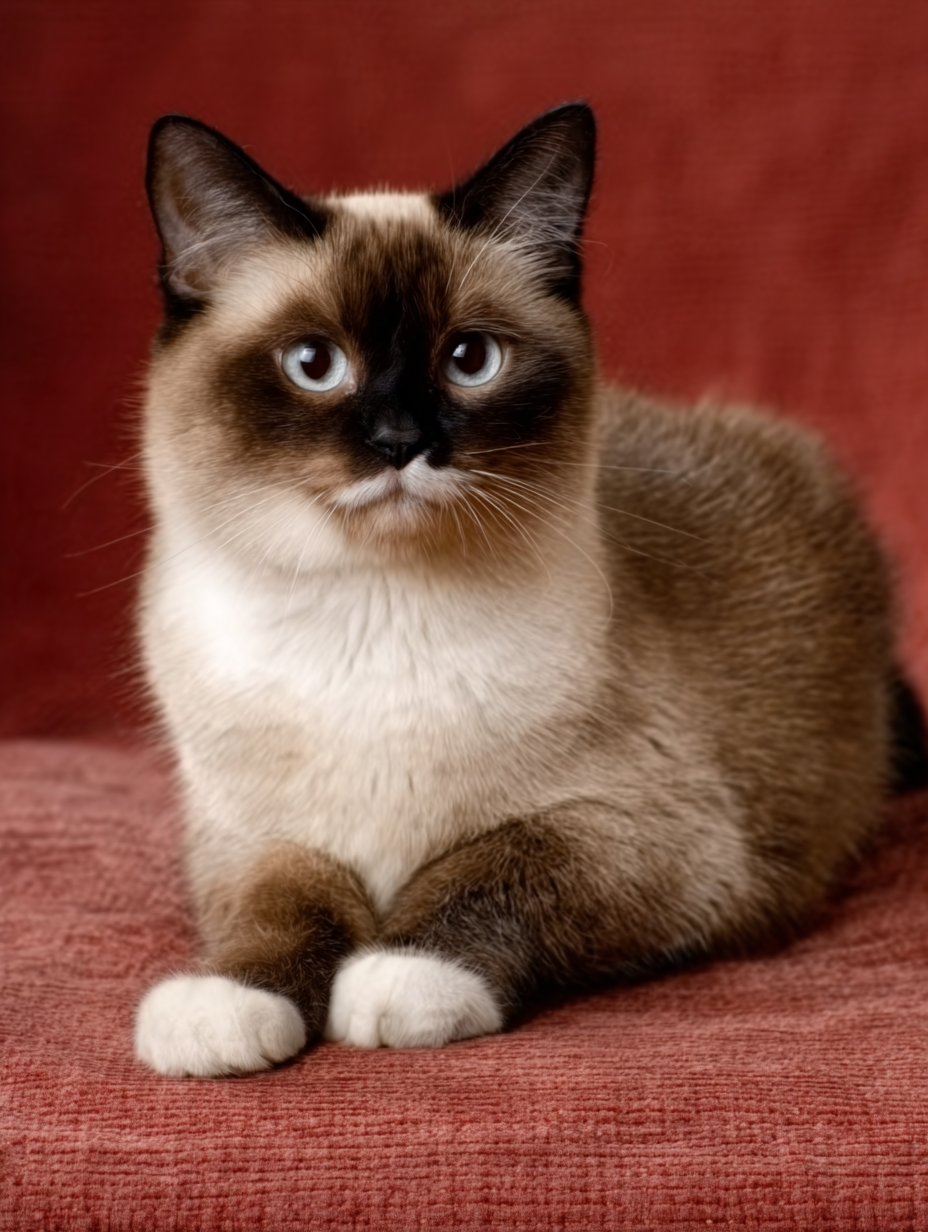
Snowshoe vs Fauxshoe: How to Tell the Difference Between a True Snowshoe and a Look-Alike
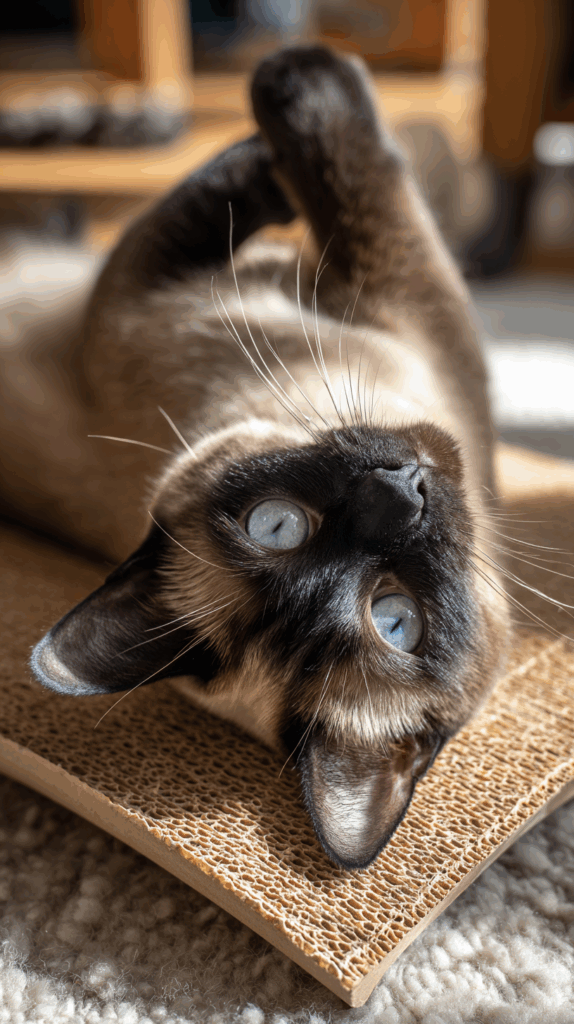
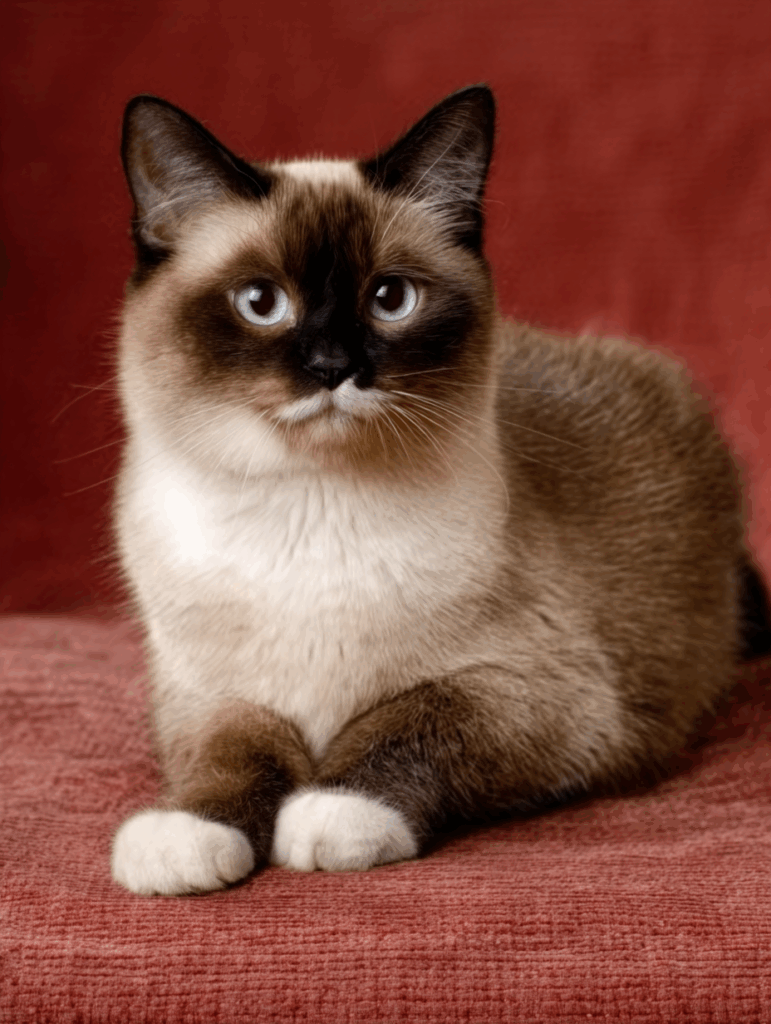
What is the difference between a Showshoe vs Fauxshoe cat? The Snowshoe and the “Fauxshoe” (any cat that resembles a Snowshoe but is not purebred or does not meet breed standards) are often confused because both may show white feet, pointed coloring, and blue eyes. However, the Snowshoe is a fully recognized breed with strict standards for body structure, markings, eye color, and temperament. A Fauxshoe may share some of these visual traits through chance genetics or mixed ancestry, but it lacks the consistency, pattern requirements, and registry-verified lineage that define a true Snowshoe.
Because Snowshoes have a genetically complex coat pattern, many people mistake bicolor Siamese mixes, domestic shorthairs with white spotting, and pointed domestic cats for Snowshoes. This comparison breaks down the exact differences so families and future owners can identify what they truly have — or are planning to adopt.
Quick Comparison Table: Snowshoe vs Fauxshoe
| Category | Snowshoe (Purebred) | Fauxshoe (Look-alike Domestic or Mix) |
|---|---|---|
| Breed Status | Fully recognized by CFA & TICA | Not a breed; no official recognition |
| Eye Color | Always blue | Can be blue, green, hazel, or mixed |
| Markings | Required white boots + inverted facial V | May have random white or no facial V |
| Point Colors | Seal, blue, chocolate, lilac | Any color or mix |
| Body Type | Medium, semi-foreign, athletic | Highly variable depending on ancestry |
| Temperament | Social, affectionate, people-oriented | Unpredictable; depends on genetics & socialization |
| Coat Length | Always short and low-maintenance | Short or long, depending on mix |
| Predictability | High — consistent breed traits | Unpredictable; varies widely |
| Price/Availability | Rare, breeder-produced, waitlists common | Common, often found in shelters |
| Genetic Consistency | Strong; breed-standard traits repeat reliably | None; each cat is unique |
This table helps owners quickly see whether a cat matches Snowshoe breed expectations or is likely a Fauxshoe.
Origin & History of the Snowshoe
The Snowshoe originates from the 1960s, when a Siamese breeder in Philadelphia noticed several kittens with white feet — an unexpected trait in pointed cats. Fascinated by the combination of Siamese points and crisp white boots, breeders began intentionally crossing Siamese with bicolor American Shorthairs to preserve the look. The goal was to combine:
- the Siamese pointed pattern
- vivid blue eyes
- the American Shorthair’s white spotting genes
- a balanced, athletic structure
- a calm, people-centered temperament
Recognition by CFA and TICA came decades later, after the breed developed consistent standards for color, pattern, temperament, and type. Today’s Snowshoes are almost exclusively produced from Snowshoe × Snowshoe or Snowshoe × Siamese (approved) pairings, making them a distinct, standardized breed.
Origin & Formation of the Fauxshoe
The Fauxshoe is not a breed. It is simply a term used to describe any cat that resembles a Snowshoe but has no breed-standard lineage. Fauxshoes can come from:
- Siamese mixes
- pointed domestic shorthairs
- bicolor cats with random white spotting
- unregistered “Snowshoe-like” backyard crosses
- shelter cats with partial Siamese ancestry
Because the white spotting gene and point coloration are fairly common across cat populations, Fauxshoes occur naturally and often. They are visually similar but genetically unrelated to standardized Snowshoe programs.
Most Fauxshoes lack the strict combination of:
- balanced white boots
- blue eyes
- inverted V facial mask
- correct point placement
- semi-foreign structure
- breed-consistent temperament
Fauxshoes make wonderful pets — but they are not purebred Snowshoes.
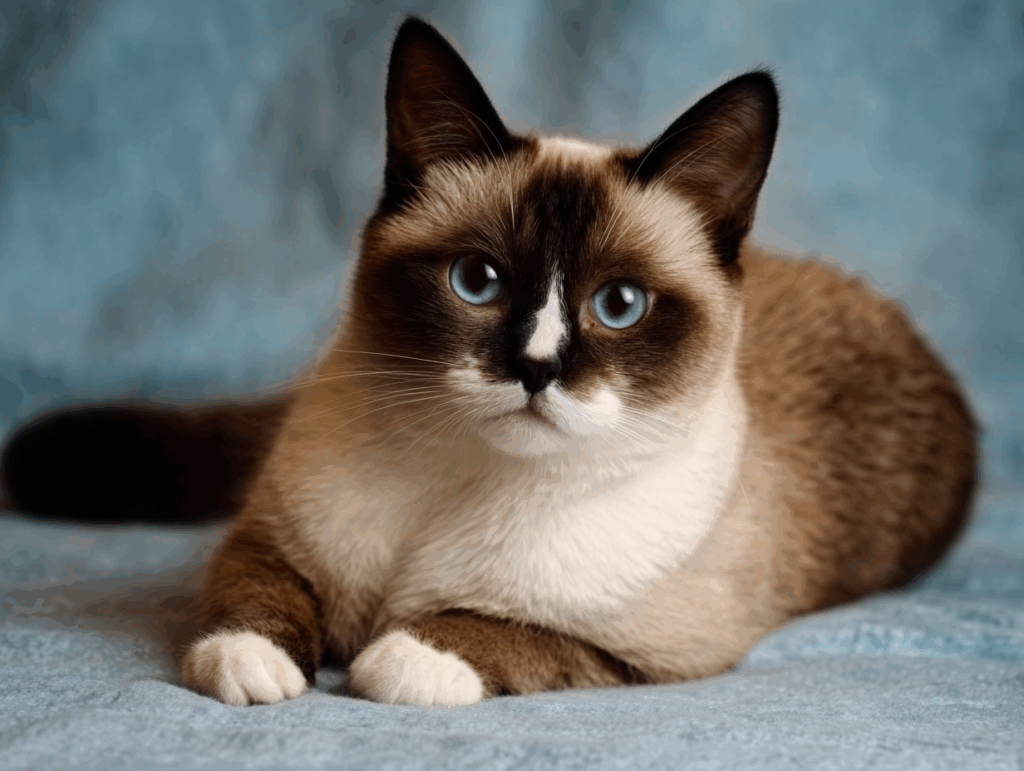
Snowshoe vs Fauxshoe Breed Recognition & Standards
Snowshoe Recognition
True Snowshoes are fully recognized by major registries:
- CFA
- TICA
- ACFA
- CCA-AFC
These organizations require that Snowshoes meet a precise set of standards for markings, eye color, structure, and temperament before registration.
Fauxshoe Recognition
Fauxshoes have:
- no breed standard
- no registry acceptance
- no specific body type or pattern requirements
- no consistency across litters
They are simply domestic cats or mixes that look similar to Snowshoes by coincidence.
How Standards Differ
Snowshoe Breed Standard Requirements:
- Blue eyes only
- Pointed coloration
- White boots on all four feet
- Inverted facial V preferred
- Medium, muscular, semi-foreign build
- Balanced proportions
- Athletic and people-oriented temperament
Fauxshoe Non-requirements:
- Any eye color
- White may appear anywhere, or not at all
- Body shape varies dramatically
- Temperament unpredictable
- No pattern symmetry required
Purebred Snowshoes follow a strict pattern; Fauxshoes do not.
Appearance: Head, Face & Expression
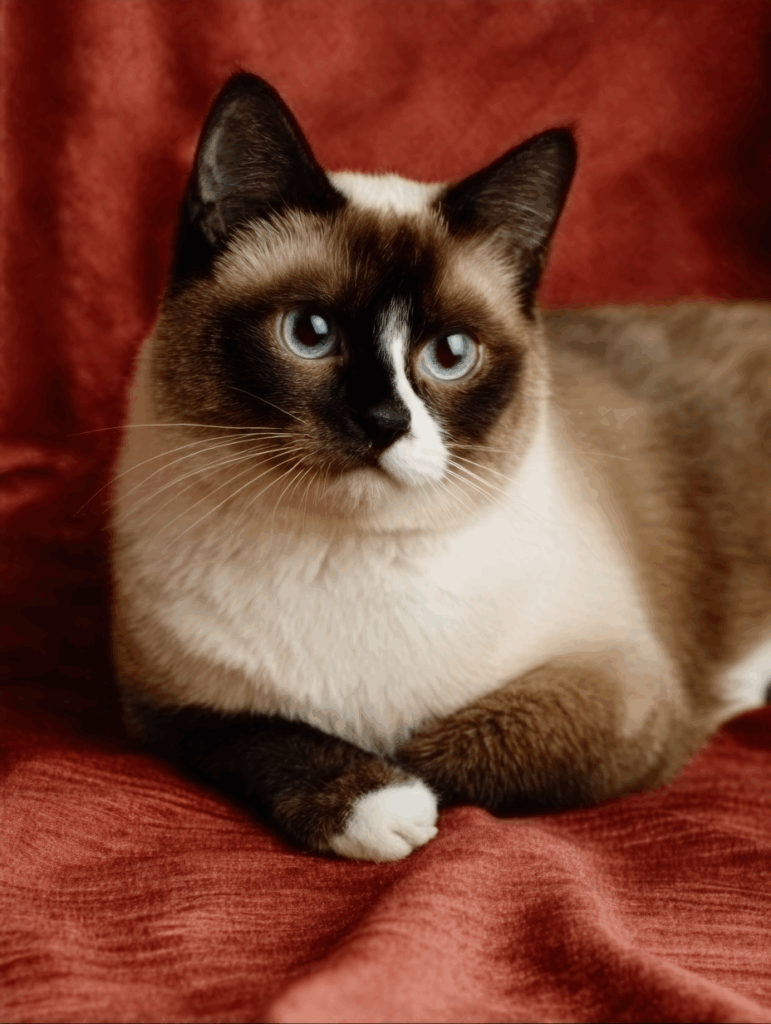
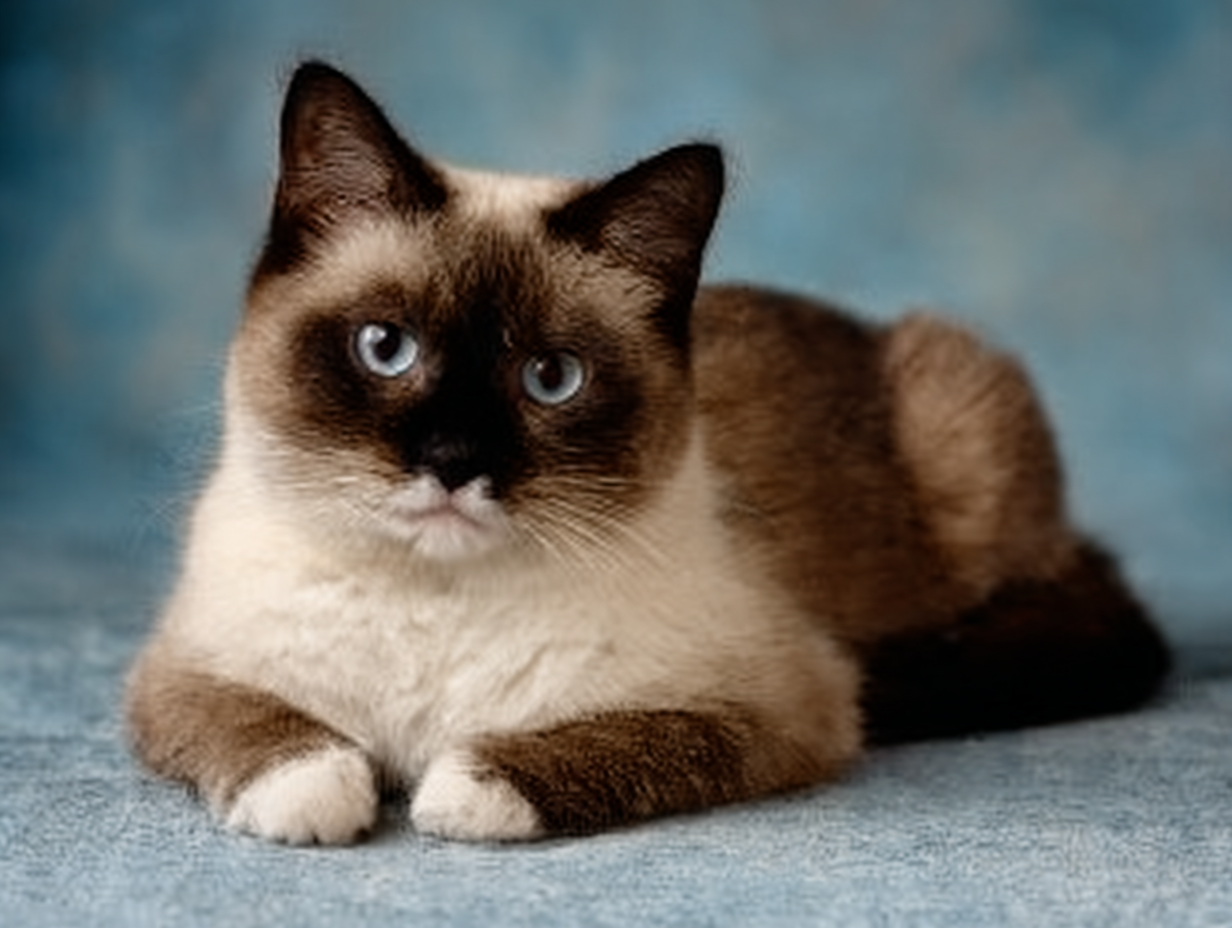
Snowshoe Face Structure
Snowshoes have:
- a gently rounded head
- medium-length muzzle
- oval or walnut-shaped blue eyes
- a distinct inverted V marking (not always perfectly symmetrical)
- medium ears with forward tilt
- expressive, intelligent facial features
Their expression combines Siamese alertness with a softer, friendlier look.
Fauxshoe Face Structure
Fauxshoes may have:
- blue, green, gold, or mixed eyes
- no facial V or a partial one
- a more angular or more rounded skull
- varying muzzle lengths
- random white patches unrelated to Snowshoe standard
Their appearance varies because their genetics are not standardized.
Eye Color Differences
Snowshoe: always blue
Fauxshoe: any color, even within the same litter
Blue eyes alone are not enough to identify a Snowshoe — but non-blue eyes instantly identify a Fauxshoe.
Coat Type & Grooming Needs: Snowshoe vs Fauxshoe
Snowshoe Coat
Snowshoes have a very predictable coat type because they come from established, standardized breeding lines. Their coat is:
- short
- sleek but soft
- close-lying
- easy to maintain
- smooth in texture
- low–moderate shedding
- resistant to matting
- uniform across the breed
Snowshoes rarely develop tangles, and their short coat keeps grooming needs simple. A quick weekly brushing is usually enough to remove loose hair and maintain shine.
Fauxshoe Coat
Fauxshoes vary tremendously because they are not a breed. Their coat can be:
- short, medium, or occasionally semi-long
- dense or sparse
- plush or sleek
- easy-care or prone to knots
- variable shedding
Since Fauxshoes can come from any combination of domestic cats, Siamese mixes, or unknown ancestry, their grooming needs range from extremely easy to unexpectedly high. A Fauxshoe may look like a Snowshoe but still require completely different coat care.
Temperament & Personality Differences
Shared Traits (Possible in Both)
Because Fauxshoes often have some Siamese ancestry, both Snowshoes and Snowshoe-like mixes may show:
- affection for people
- social behavior
- vocal or expressive communication
- intelligence
- curiosity
- attachment to their families
However, only the Snowshoe has predictable temperament traits across generations.
Snowshoe Personality
Snowshoes are known for:
- gentle affection
- people-oriented bonding
- playful but not high-energy personalities
- calm companionship
- emotional stability
- a tendency to follow their people from room to room
- enjoying routine and social interaction
Snowshoes strike a balance between Siamese expressiveness and American Shorthair steadiness. Their personality is one of the most reliable traits of the breed.
Fauxshoe Personality
Fauxshoe cats can behave in any way because their temperament depends entirely on whatever breeds or domestic traits appear in their bloodline.
Common Fauxshoe temperaments include:
- highly vocal Siamese-like behavior
- shy and reserved domestic shorthair traits
- bold, outgoing personalities
- aloof or independent temperaments
- unpredictable play levels
A Fauxshoe’s personality cannot be assumed based on appearance.
Shedding, Coat Care & Allergy Considerations
Shedding Patterns
Snowshoe shedding:
- low to moderate
- increases in spring and fall
- easy to control with weekly brushing
Because their coat lies close to the body and lacks long guard hairs, loose fur is easy to remove.
Fauxshoe shedding:
- can be light, moderate, or extremely heavy
- depends on the cat’s ancestry
- long or plush-coated Fauxshoes may shed significantly more than Snowshoes
The amount of shedding varies widely and cannot be predicted from appearance alone.
Allergy Profile
Neither Snowshoes nor Fauxshoes are hypoallergenic.
However:
- Snowshoes may be easier for some allergy-sensitive families because their coats do not trap as much dander or debris.
- Fauxshoes may be easier or harder depending on coat length, dander production, and grooming requirements.
The difference is not about the name — it’s about the coat.
Seasonal Coat Changes
Snowshoe seasonal changes:
- short coat blows lightly in spring/fall
- simple grooming prevents buildup
- fur does not form mats
Fauxshoe seasonal changes:
- unpredictable
- some shed minimally
- others undergo heavy coat drops
- semi-long Fauxshoes may mat without care
Grooming needs vary dramatically depending on the mix.
Grooming Requirements: Low-Maintenance vs Variable
Snowshoe Grooming Needs
Snowshoes are one of the easiest pointed breeds to maintain. A typical routine includes:
- brushing once per week
- wiping eyes if mild tearing occurs
- occasional baths (optional)
- nail trims and ear cleaning as needed
Snowshoes typically require less than 10 minutes of grooming per week.
Fauxshoe Grooming Needs
Fauxshoe grooming varies depending on coat type:
- short-haired Fauxshoes may need minimal care
- plush-coated Fauxshoes may require multiple weekly brushings
- medium-coated Fauxshoes may tangle if not groomed
- some may need tear-stain management if they inherit Siamese facial traits
Because Fauxshoes are not standardized, care needs should be evaluated on an individual basis rather than by appearance.
Grooming & Maintenance Summary Table: Snowshoe vs Fauxshoe
| Topic | Snowshoe | Fauxshoe |
|---|---|---|
| Daily Brushing | Not required | Depends on coat type |
| Matting Risk | Very low | Low to high (variable) |
| Bathing Needs | Occasional | Variable |
| Tear Staining | Mild | Mild to moderate |
| Coat Tools Needed | 1–2 tools | 1–5 tools depending on the mix |
| Weekly Grooming Time | 5–10 minutes | 5–40 minutes depending on coat |
| Predictability | High | None |
Health & Genetic Concerns in Snowshoes vs Fauxshoes
Snowshoes and Fauxshoes can look similar, but their health profiles are not comparable.
Snowshoes have predictable breed traits because they come from standardized, registered lines.
Fauxshoes vary dramatically because they can come from any mix of Siamese, domestic shorthair, biracial pointed crosses, or unknown ancestry.
Shared Genetic Considerations (Possible in Both)
Because Fauxshoes often involve Siamese or pointed breeds, both Snowshoes may share certain tendencies:
- mild tear overflow from pointed facial structure
- sensitivity to respiratory irritation
- possible dental crowding in some lines
- increased vocal expressiveness (if Siamese influence is strong)
- temperature-sensitive coat/color genes
However, these traits are more predictable in Snowshoes and completely random in Fauxshoes.
Snowshoe-Specific Health Realities
Snowshoes from reputable breeding programs are typically screened for:
- HCM (Hypertrophic Cardiomyopathy)
- Dental alignment issues
- Basic genetic panel testing (colorpoint gene, blood type, coat gene)
- General structural soundness
They do not carry any breed-specific lethal genes, dwarfism mutations, brachycephaly, or coat-related skin risks.
Common Snowshoe tendencies may include:
- tear staining depending on head shape
- mild respiratory sensitivity in overly wedge-headed lines
- early dental tartar buildup
- moderate weight gain in low-exercise homes
These are manageable and predictable.
Fauxshoe-Specific Health Realities
Because Fauxshoes are not a standardized breed, their health can vary widely depending on ancestry:
- Some are extremely healthy, hardy domestic mixes.
- Some may carry genetic issues from Siamese, Ragdoll, American Shorthair, or unknown lines.
- Some may have dental issues related to mismatched head shapes.
- Some may have temperament-linked stress that affects their immune health.
- Some may carry recessive conditions from untested parents.
Possible risks (depending on mix):
- HCM (common in Siamese/Ragdoll ancestry)
- PKD (if Persian/Exotic ancestry sneaks into lines)
- autoimmune gingivitis (seen in some domestic lines)
- chronic respiratory irritation in wedge-headed Siamese types
- unpredictable temperament-linked stress behaviors
Health cannot be assumed in Fauxshoes based on appearance alone.
Snowshoe vs Fauxshoe Lifespan & Longevity Comparison
Snowshoe Lifespan
12–16+ years
Well-bred Snowshoes often reach older ages due to controlled breeding, predictable genetics, and careful selection for structure and temperament.
Most reputable lines emphasize:
- heart health
- solid bone structure
- balanced facial proportions
- manageable energy levels
Snowshoes tend to age gracefully and stay active well into their senior years.
Fauxshoe Lifespan
Highly variable: 10–18+ years
Because Fauxshoes come from unpredictable ancestry, their lifespan depends entirely on:
- genetics of the parents
- environment
- nutrition
- stress levels
- veterinary care
- inherited conditions from unknown lines
Some Fauxshoes live exceptionally long lives (hardy domestic stock).
Others may inherit early-onset heart, dental, or immune issues from mixed ancestry.
Why Snowshoes Often Experience More Predictable Health Outcomes
Snowshoes benefit from:
- controlled lineage
- intentional pairing
- known genetic diversity
- breeder screening
- standardized structure
- temperament predictability
Fauxshoes do not have these safeguards.
Predictability is the biggest difference — Snowshoes follow a pattern, Fauxshoes follow possibility.
Activity Level & Playfulness
Snowshoe Activity Levels
Snowshoes are medium-energy cats with bursts of playful activity. They enjoy:
- puzzle toys
- wand toys
- supervised climbing
- interactive play
- following their owners around
They are not hyper like Siamese but not sedentary like Persians.
Fauxshoe Activity Levels
A Fauxshoe may be:
- extremely active (Siamese-heavy mix)
- mellow and quiet (DSH-heavy mix)
- unpredictable (mixed ancestry)
- socially needy or independent
There is no guaranteed pattern.
Energy level is determined by whatever genetics are dominant in the mix.
Compatibility With Families, Seniors & Other Pets
Snowshoe Compatibility
Snowshoes are typically:
- excellent with families
- good with respectful children
- social with other cats
- tolerant of calm dogs
- adaptable to apartments
- interactive without being clingy
They bond deeply and tend to follow their chosen person.
Fauxshoe Compatibility
A Fauxshoe may thrive or struggle depending on personality:
- Some are cuddly and outgoing.
- Some are anxious and shy.
- Some bond tightly; others remain independent.
- Some enjoy noise; others avoid it.
Without breed-level predictability, Fauxshoe compatibility must be evaluated on an individual basis, not by appearance.
Snowshoe vs Fauxshoe Cost of Ownership: Upfront, Ongoing & Long-Term
Snowshoe Price Range
Because Snowshoes are a recognized breed (TICA, CFA in some regions) and selectively bred:
- Pet quality: $800–$2,000+
- Show/breeding quality: $2,000–$3,500+
- Rare markings or perfect white boots: higher
Pricing is based on:
- correct Snowshoe markings
- eye color (blue preferred)
- breeder reputation
- pedigree quality
- registration
Fauxshoe Price Range
Fauxshoe cats appear everywhere, and pricing varies widely:
- $50–$300 (shelters)
- $150–$800 (unregistered mixes sold as “Snowshoe-like”)
- unique colors or patterns may sell for more, but not legitimately Snowshoe value
Because Fauxshoes are not standardized, “Snowshoe prices” for unregistered cats are often inflated.
Lifetime Maintenance Costs
Snowshoe
Low–moderate cost of care:
- minimal grooming needs
- predictable health screening costs
- normal dental care
- occasional tear-stain wipes
- routine vet visits
No special grooming or breed-specific deficiencies increase long-term costs.
Fauxshoe
Costs vary widely based on coat and health:
- may need more frequent vet visits if genetics are unknown
- may have inconsistent dental development
- coat type may require more grooming
- temperament may influence stress-related medical needs
A Fauxshoe could be extremely inexpensive or surprisingly demanding.
Shedding, Home Cleaning & Daily Impact
Snowshoe Shedding Profile
- moderate shedding
- easy to vacuum
- short coat that doesn’t mat
- predictable seasonal coat drops
Home maintenance remains simple.
Fauxshoe Shedding Profile
Completely unpredictable:
- some shed lightly
- some shed intensely
- medium-coated Fauxshoes may mat
- some produce more airborne hair depending on coat density
Cleaning needs depend on the individual coat type, not the “Snowshoe look.”
Beginner-Friendly Comparison: Snowshoe vs Fauxshoe — Which Is Easier?
Snowshoe for Beginners
Snowshoes are widely considered a beginner-friendly purebred cat because they combine:
- low grooming needs
- predictable temperament
- moderate, enjoyable activity level
- excellent family compatibility
- social but not overwhelming personality
- low maintenance cost compared to longhaired breeds
A well-bred Snowshoe offers a stable temperament, easy-to-maintain coat, and dependable behavior patterns that help new owners feel confident from day one.
Fauxshoe for Beginners
Fauxshoes (Snowshoe look-alikes) may or may not be beginner-friendly. Their suitability depends entirely on the mix behind the pattern.
A Fauxshoe may be:
- very vocal and demanding (if Siamese-heavy)
- independent or shy (if domestic shorthair-heavy)
- unpredictable in play style
- inconsistent in social needs
- lower or higher maintenance depending on coat type
New owners often mistakenly assume Fauxshoes behave like Snowshoes because they have similar markings. In reality, Fauxshoe behavior is unpredictable, making them more variable for beginners.
Both can be lovely cats, but Snowshoes are far more predictable and beginner-compatible.
Overall Health Comparison: Snowshoe vs Fauxshoe
Snowshoe Health Outlook
Snowshoes generally have strong overall health when responsibly bred. They benefit from:
- intentional selection for structure
- predictable genetics
- known parentage
- basic health testing (HCM, dental oversight)
Their short coat avoids many hygiene-related risks, and their moderate head shape supports comfortable breathing.
Common Snowshoe tendencies:
- mild tear staining
- early tartar buildup
- occasional respiratory sensitivity
These are manageable and predictable.
Fauxshoe Health Outlook
Fauxshoe cats may be extremely healthy or have hidden health issues, depending on parentage. Fauxshoes may inherit:
- HCM (in Siamese/Ragdoll-heavy mixes)
- PKD (if Persian/Exotic genes appear in ancestry)
- autoimmune gingivitis
- respiratory irritation in wedge-headed mixes
- digestive sensitivity depending on breed influence
Because Fauxshoes come from untracked, untested backgrounds, health outcomes are individual, not breed-based.
Conclusion on Health: Snowshoe vs Fauxshoe
Snowshoes tend to have more consistent, stable health due to controlled breeding.
Fauxshoe health depends entirely on the unverified mix behind their markings.
Predictability is the deciding factor.
Choosing the Right Cat for Your Household
Choose a Snowshoe If You Want:
- reliable temperament
- moderate energy and social interaction
- easy grooming
- a cat suited for families, seniors, or multi-pet homes
- a known lineage with predictable health
- blue eyes and classic Snowshoe markings
- a balanced mix of affection + independence
Snowshoes are ideal for most families, including first-time owners.
Choose a Fauxshoe If You Want:
- a rescue cat with Snowshoe-like markings
- a lower-cost adoption option
- a unique personality that isn’t bound to breed expectations
- a cat whose behavior you’re willing to get to know as it unfolds
Fauxshoes can be wonderful companions, but their traits are unpredictable, and they cannot be relied on to behave like a Snowshoe simply because they resemble one.
Which Cat Is Better for Allergies?
Allergy Considerations
Neither Snowshoes nor Fauxshoes are hypoallergenic.
However, coat type plays a major role in allergen management.
Why Snowshoes Are Often Easier for Allergy-Sensitive Owners
- short coat → less dander retention
- easy to wipe down
- sheds in predictable cycles
- easier to groom
Snowshoes still produce allergens, but their coat is easier to maintain and keep clean.
Why Fauxshoes May Be More Challenging
Depending on coat genetics, Fauxshoes may have:
- medium or dense coats that trap more dander
- inconsistent shedding
- difficulty cleaning themselves efficiently
- varying allergen levels tied to ancestry
For families with allergies, Snowshoes are generally the more manageable choice.
Snowshoe vs Fauxshoe Comparison Table
| Feature | Snowshoe | Fauxshoe |
|---|---|---|
| Coat Type | Short, sleek, low-maintenance | Variable: short, medium, or plush |
| Grooming Needs | Low | Low–high depending on mix |
| Personality | Predictable, affectionate, social | Unpredictable, mix-dependent |
| Shedding | Moderate, predictable | Highly variable |
| Health Risks | Known, screened for in breeding | Unknown or mixed |
| Beginner-Friendly | Yes | Sometimes |
| Lifespan | 12–16+ years | 10–18+ years (variable) |
| Good for Families | Yes | Case-by-case |
| Cost | Higher due to purebred lineage | Low–moderate (adoption or unregistered sales) |
| Temperament Stability | High | Unpredictable |
| Registry Recognition | CFA/TICA | None |
Myths About Snowshoe Cats (and Fauxshoes): What’s True and What’s Not
Because Snowshoe cats have distinctive markings — white boots, inverted “V” mask, blue eyes, and colorpoint patterns — many mixed-breed cats resemble them. This leads to confusion, misinformation, and widespread myths about what is or isn’t a true Snowshoe. Below are the most common myths families encounter when trying to identify or understand this breed.
Myth 1: “Any cat with white paws and points is a Snowshoe.”
Fact: This is the most common misconception. Many domestic shorthair mixes can produce similar patterns, especially if they carry Siamese ancestry. True Snowshoes have specific pattern requirements, predictable white markings, and structurally consistent features. A cat may look Snowshoe-ish and still be a Fauxshoe with no Snowshoe lineage at all.
Myth 2: “Snowshoes always have perfect symmetrical white boots.”
Fact: Even in purebred Snowshoes, marking symmetry is one of the hardest traits to achieve. Perfect boots are rare and are often considered show-quality. Many real Snowshoes have irregular socks or slightly uneven patterns. Fauxshoes tend to have unpredictable white spotting that doesn’t match Snowshoe standards.
Myth 3: “All Snowshoe cats have an inverted white V mask.”
Fact: The inverted V is common but not universal. Snowshoes can have partial masks, wide Vs, narrow Vs, or irregular white facial markings. Fauxshoes often have scattered facial white that doesn’t shape into a defined V, but appearance alone does not confirm genetics.
Myth 4: “Snowshoes have the same personality as any pointed or Siamese-looking cat.”
Fact: Snowshoes have a temperament that blends American Shorthair stability with Siamese social intelligence. Fauxshoes vary widely. Some are loud and intense, others shy and quiet, depending on their mix. A cat’s markings do not dictate behavior.
Myth 5: “Snowshoes are hypoallergenic.”
Fact: They are not. Snowshoes shed a normal amount and produce the same allergens as domestic shorthairs. Their short coat is easy to groom, but it does not make them hypoallergenic. Fauxshoes also vary — none are hypoallergenic by default.
Myth 6: “Blue eyes mean a Snowshoe cat.”
Fact: Many cats with point-coloration have blue eyes: Siamese, Ragdolls, mixes, Tonkinese, Balinese, pointed domestics, and various rescues. Blue eyes come from the colorpoint gene, not Snowshoe genetics. Fauxshoes often have blue eyes simply because of Siamese ancestry.
Myth 7: “A rescue can always identify a Snowshoe by sight.”
Fact: Most rescues identify by appearance only, not genetic lineage. Many “Snowshoe” cats in shelters are Fauxshoes with no registration, pedigree, or verifiable ancestry. Appearance-based labels are convenient for adoption listings but are not proof of breed.
Myth 8: “Snowshoe cats are rare and expensive because breeders manipulate traits.”
Fact: Snowshoes are rare because their white markings are hard to produce consistently and because breeding programs are small. They are not the result of extreme traits or unhealthy selection. Fauxshoes, on the other hand, occur naturally and commonly in mixed litters.
Myth 9: “Snowshoes are high-energy like Siamese.”
Fact: Snowshoes can be social and interactive, but they are far more moderate than Siamese. They are not hyperactive, demanding, or constantly vocal. Fauxshoes, depending on mix, may show extremes in vocalization or energy that real Snowshoes do not.
Myth 10: “Snowshoes are easy to identify by their body type.”
Fact: Snowshoes have a specific, muscular, medium-bodied build with wedge-shaped facial structure and balanced proportions. Fauxshoes may be more slender, rounder, heavier-boned, or shaped entirely differently. Body type is part of breed identity, but it requires familiarity to assess correctly.
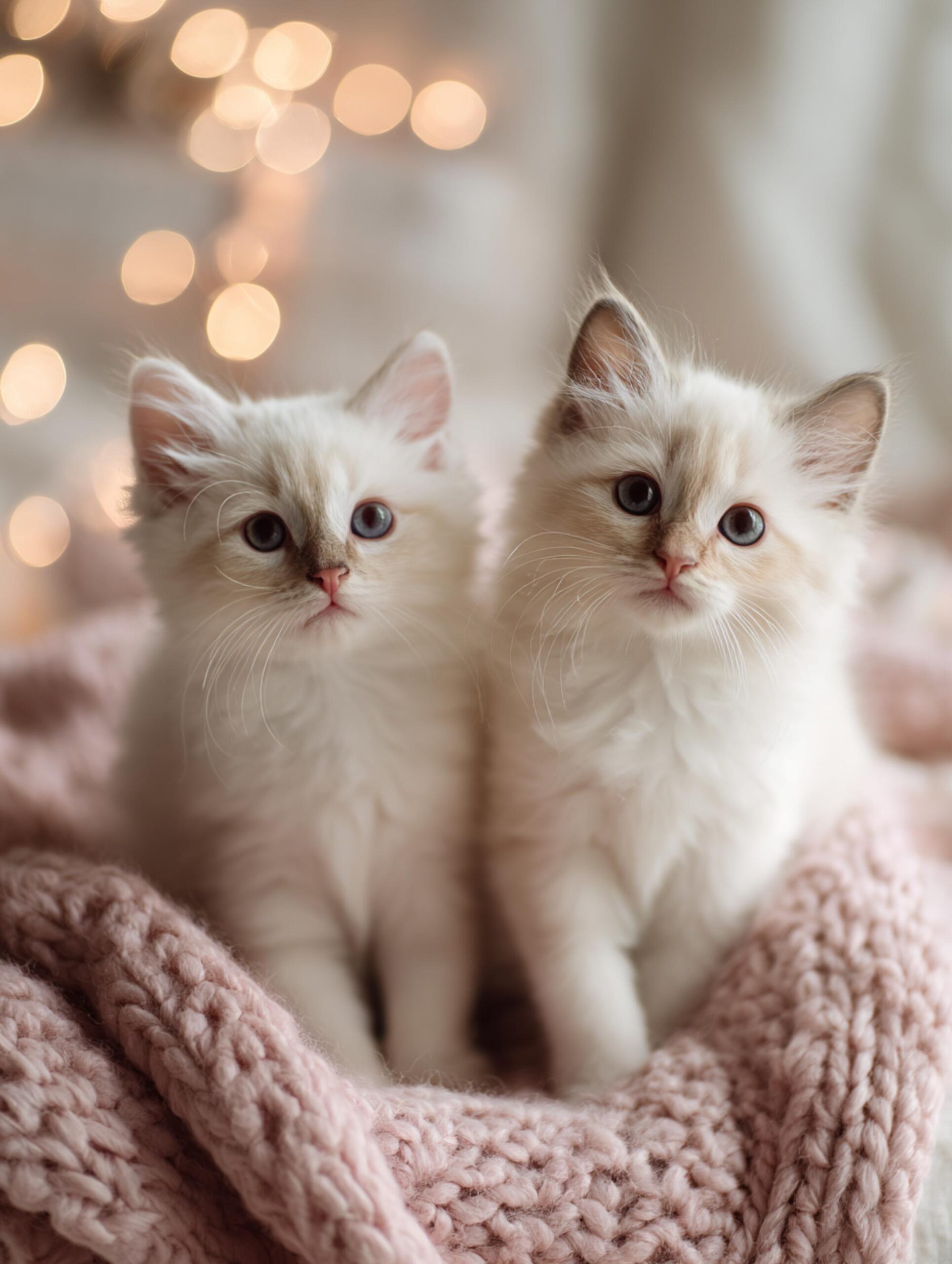
Myth 11: “Snowshoe kittens are born with white paws.”
Fact: Snowshoe kittens are born pure white or extremely pale — their points and markings develop over weeks to months. Fauxshoe mixes often develop markings earlier or have inconsistent color progression. Early color does not reliably identify breed.
Myth 12: “Snowshoes can be bred by pairing any pointed cat with a white cat.”
Fact: True Snowshoes come from controlled lineage using specific bloodlines and structured pairings overseen by breed clubs. Random point × white crosses produce Fauxshoes with unpredictable results, color bleed, mismatched markings, or incorrect structure.
Myth 13: “Fauxshoe cats are automatically lower-quality or undesirable.”
Fact: Fauxshoe cats can be wonderful companions with fantastic temperaments and beautiful patterns — they simply aren’t purebred Snowshoes. Many families adore Fauxshoes, especially those adopted from shelters, but they should not be represented as Snowshoes without proof of lineage.
Myth 14: “A cat with incorrect markings cannot be a real Snowshoe.”
Fact: Breed standards describe ideal markings, not mandatory ones. Even purebred Snowshoes can have imperfect socks or masks. Breed identity is based on lineage, structure, and traits — not perfect boots.
Myth 15: “Snowshoes are fragile or delicate because they are rare.”
Fact: Snowshoes are healthy, athletic, and sturdy cats with robust body structure. Fauxshoes may be equally hardy, but Snowshoes’ consistency comes from been selectively bred for soundness and temperament.
Snowshoe Cat vs Fauxshoe Cat : FAQ
Are Snowshoe cats rare?
Yes. Snowshoe cats are considered a rare breed because producing correct markings is extremely difficult and because the breed has a small, carefully preserved gene pool. True Snowshoes require specifically placed white boots, an inverted facial “V,” blue eyes, and balanced point coloration — traits that do not reliably appear without structured, multi-generation breeding. Fauxshoe cats, on the other hand, are common because similar patterns can show up randomly in mixed-breed cats, especially those with Siamese ancestry. Rarity comes from lineage, not from appearance alone.
How can I tell if my cat is a real Snowshoe?
The only definitive way to confirm Snowshoe identity is through verified lineage, registration, or breeder documentation. Visual traits can help, but they are not enough on their own. Real Snowshoes typically have blue eyes, white boots, point coloration, a short coat, and a muscular medium body. Fauxshoes often share some of these traits but lack Snowshoe structure, symmetry, and temperament predictability. Without papers or breeder verification, the safest assumption is that the cat is a Fauxshoe, even if it looks extremely close to the standard.
Do Snowshoe cats always have blue eyes?
Yes. Blue eyes are a requirement in the Snowshoe breed standard and occur because Snowshoes inherit the colorpoint gene from Siamese ancestry. Fauxshoe cats may also have blue eyes, but mixed or snowshoe-like cats sometimes develop aqua, pale green, or mismatched eye tones depending on their genetic background. If a cat has non-blue eyes, it cannot be considered a purebred Snowshoe.
What is the difference between a Snowshoe and a Fauxshoe?
A Snowshoe is a purebred, registered cat that adheres to an established breed standard involving structure, temperament, markings, and lineage. A Fauxshoe is a Snowshoe look-alike — usually a mixed-breed cat with Siamese or colorpoint ancestry that mimics Snowshoe markings without sharing the breed’s genetic consistency. Fauxshoes may have white paws or mask-like faces, but their temperament, structure, and markings vary widely and cannot be predicted across generations.
Do Snowshoe cats have to have an inverted ‘V’ on their face?
Most Snowshoes display an inverted white V, but not all of them do. Even well-bred Snowshoes can have masks that are too wide, too narrow, or slightly asymmetrical. Fauxshoe cats often have white on the face, but it tends to appear in irregular or disconnected shapes rather than a symmetrical V. While the V is iconic, breed identity is based on lineage and overall traits, not a single marking.
Are Snowshoe cats part Siamese?
Yes. The Snowshoe breed was created by combining Siamese cats with American Shorthairs to produce a pointed cat with white boots, blue eyes, and a more moderate, muscular structure. Fauxshoe cats often have strong Siamese influence as well, but their additional ancestry is usually unknown. Snowshoes reflect a carefully balanced blend of Siamese coloring with American Shorthair stability, whereas Fauxshoes vary widely based on whichever genes happened to be present.
Do Fauxshoe cats behave like Snowshoes?
Not necessarily. Snowshoes have a consistent temperament: calm, affectionate, moderately vocal, people-oriented, and highly social without being hyperactive. Fauxshoes may inherit energetic Siamese behavior, shy domestic shorthair tendencies, or unpredictable temperaments depending on their background. Visual similarity does not guarantee similar personality traits. The Fauxshoe’s behavior should be evaluated individually rather than assumed based on its appearance.
Why do so many shelter cats get labeled as Snowshoes?
Shelters identify cats by appearance, not genetics. Because the Snowshoe look — white boots + colorpoint pattern + blue eyes — can occur naturally in many domestic mixes, shelters frequently use the term “Snowshoe” for marketing or simplicity. These cats are almost always Fauxshoes. Without registration, pedigree, or breeder history, a shelter “Snowshoe” should be considered a Snowshoe-like mix.
Do Snowshoe kittens look different from adult Snowshoes?
Yes. Snowshoe kittens are born almost entirely white. Their points, boots, and mask appear gradually over the first several weeks. Fauxshoe kittens often develop markings earlier, inconsistently, or with different color distribution. Snowshoe kittens typically gain color in a predictable pattern, while Fauxshoe kittens may darken or change unpredictably depending on their mix.
What colors do Snowshoe cats come in?
Snowshoes come in seal point, blue point, chocolate point, lavender (lilac) point, and occasionally other dilute variations depending on registry. All Snowshoes display white markings in very specific patterns. Fauxshoe cats can come in any color or hybrid variation because they are not bound to breed standards. A Fauxshoe may mimic Snowshoe colors but without the precision of true Snowshoe patterns.
Are Snowshoes good pets for families?
Yes. Snowshoes are known for balanced temperament — playful but not hyper, affectionate but not overwhelming, social but not demanding. They thrive in households with children, adults, seniors, and even other pets. Fauxshoes can also be wonderful family pets, but their behavior is influenced by unknown ancestry, so families should be prepared for more variability in energy level and social needs.
Are Snowshoe cats hypoallergenic?
No breed is genuinely hypoallergenic, including Snowshoes. Their short coat may shed less than longhaired breeds, but they still produce dander and allergens. Fauxshoe cats may shed more or less depending on coat length, texture, and ancestry. Allergy-prone households should expect typical feline allergens with both Snowshoes and Fauxshoes.
Why are Snowshoe cats more expensive than similar-looking cats?
Snowshoes cost more because their traits are difficult to breed consistently. Achieving symmetrical boots, correct mask shape, strong blue eyes, predictable temperament, and sound structure requires selective generation-by-generation breeding. Fauxshoe cats often cost very little because they are typically unregistered mixes. Their markings appear naturally through recessive genetics rather than through structured breeding programs.
Do Fauxshoe cats make good pets even if they aren’t real Snowshoes?
Absolutely. Fauxshoes can be loving, playful, stunning, and full of personality. The only difference is that they lack the predictability, structure, and lineage of the Snowshoe breed. Many families adore Fauxshoe cats from shelters or rescues, but it’s important not to mistake them for purebred Snowshoes without documentation.
Can DNA tests tell me if my cat is a Snowshoe?
Not reliably. Current commercial DNA tests can detect broad breed groups such as “Siamese-type,” “American Shorthair-type,” or “Colorpoint.” They cannot confirm Snowshoe-specific ancestry because Snowshoes share much of their genetic heritage with Siamese and domestic shorthairs. The only definitive proof of a true Snowshoe is pedigree documentation from a recognized breeder or registry.
12-Point Checklist: How to Tell If Your Cat Is a Real Snowshoe (Not a Fauxshoe)
Each point reflects traits consistently found in true Snowshoes — and inconsistently found in Fauxshoes.
1. Pedigree or Breeder Documentation
This is the only certain form of proof. A true Snowshoe will have registration through CFA, TICA, or a recognized Snowshoe breeder. Without documentation, the cat is almost always a Fauxshoe, no matter how authentic the markings appear.
2. Eye Color: Must Be Blue
All Snowshoes have blue eyes due to the colorpoint gene. Fauxshoes may have blue eyes too, but they may also have aqua, greenish-blue, pale green, or mixed hues. Any non-blue eye color immediately indicates Fauxshoe status.
3. White Boots/Socks in a Specific Range
Snowshoes have controlled white spotting:
- front paws: mittens
- back paws: higher boots
- markings designed to fall within a consistent pattern range
Fauxshoes may have random white patches, mismatched socks, or overly high stockings inconsistent with breed standards.
4. Inverted “V” Mask Formation
While not required, the inverted V mask is iconic in Snowshoes and usually symmetrical. Fauxshoes often have scattered face white or partial blazes that do not form a clean V.
5. Point Coloration (Seal, Blue, Chocolate, Lilac)
Snowshoes come in point colors only. Fauxshoes may show non-standard hues, tabby combinations that break the V, or excessive white that disrupts point contrast.
6. Coat Type: Short, Sleek, and Easy-Care
True Snowshoes have a short, smooth coat with close-lying hair. Fauxshoes may have plush, dense, medium, or semi-long coats depending on their mix.
7. Body Structure: Medium, Muscular, Balanced
Snowshoes are not slender like Siamese nor round like American Shorthairs, but a blend:
- medium bone
- athletic formulation
- strong rear leg development
Fauxshoes commonly show extremes in body type.
8. Head Shape: Modified Wedge
Snowshoes have a gentle wedge-shaped head with defined cheekbones and a soft muzzle. Fauxshoes may have rounder domestic heads or narrower Siamese-style wedge shapes.
9. Personality: Social, Moderate, and People-Focused
Snowshoes are reliably affectionate, interactive, and emotionally stable. Fauxshoe personalities range from shy to hyper to vocal to aloof depending on ancestry.
10. Voice Level: Soft to Moderate
Snowshoes talk, but softly. Fauxshoes with strong Siamese lines may be dramatically louder or more demanding.
11. Predictability Across Littermates
Snowshoe kittens from reputable breeders develop consistent appearance and temperament. Fauxshoe litters vary wildly — some look pointed, some don’t, some talk nonstop, others hide.
12. Origin of the Cat
If your cat came from:
- a shelter
- the street
- an unregistered seller
- Craigslist
- a backyard breeder
—it is almost certainly a Fauxshoe. Snowshoes come from planned lineage and intentional breeding.
Summary: Snowshoe vs Fauxshoe — What Owners Should Know
Snowshoe cats and Fauxshoe look-alikes share surface similarities, but they are not the same. A true Snowshoe comes from documented lineage, predictable markings, and generations of carefully shaped temperament and structure. Fauxshoe cats may resemble Snowshoes visually, yet their genetics, behavior, coat type, and long-term traits follow no consistent pattern.
If your cat came from a shelter, mixed-breed litter, found home, or unregistered seller, it is almost certainly a Fauxshoe — and that’s completely fine. Fauxshoes can be wonderful companions. But families seeking the reliability, blue-eyed expression, classic white boots, and affectionate, moderate temperament the Snowshoe is known for should look for a breeder who produces verified, registered Snowshoe kittens with predictable results.
Looking for a well-bred, well-socialized kitten from Almonte Cats?
View our kittens or join the waitlist to find your future soul cat today.
Related Reading
Cat Breed Comparisons :
- Ragamuffin vs Munchkin
- Bengal vs Maine Coon
- Exotic Shorthair vs Persian
- British Shorthair vs Persian Cat
- Ragdoll vs Siamese
- Ragdoll vs Persian
- British Shorthair vs Scottish Fold
- Maine Coon vs Norwegian Forest Cat
- Ragdoll vs Himalayan
- Ragdoll vs Ragamuffin
Color Point Cat Posts:
Sources
- CFA – Snowshoe Breed Standard
https://cfa.org/snowshoe - TICA – Snowshoe Breed Information
https://tica.org/breeds/browse-all-breeds?view=article&id=880:snowshoe-cat-breed - International Cat Care – Feline Health, Behavior & Genetics
https://icatcare.org - UC Davis Veterinary Genetics Laboratory – Colorpoint & White Spotting Genetics
https://vgl.ucdavis.edu/services/cat - Cornell Feline Health Center – Feline Genetics & General Health
https://www.vet.cornell.edu/departments-centers-and-institutes/cornell-feline-health-center - Merck Veterinary Manual – Feline Inherited Conditions
https://www.merckvetmanual.com - Royal Veterinary College – Feline Anatomy & Breed Structure
https://www.rvc.ac.uk - AVMA – Cat Health & Care Guidelines
https://www.avma.org - Waltham Petcare Science Institute – Feline Research
https://www.waltham.com - PubMed – Peer-Reviewed Studies on Feline Genetics & Coat Patterns
https://pubmed.ncbi.nlm.nih.gov - ASPCA – Feline Behavior & Identification Notes
https://www.aspca.org





Read the Comments +